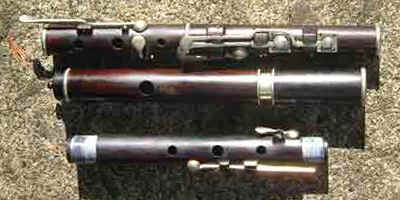
Keys marked C
The C# touch on my Geo Rudall, Willis Fecit flute is
neatly stamped with a capital C.

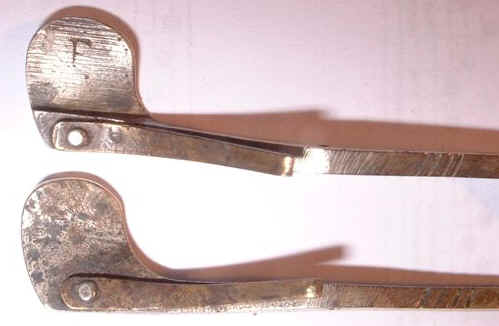
Keys marked F
C and C# foot keys from an unmarked flute resembling a
Wylde.
Note the F mark under one touch, and the four slashes on both
shafts. F also appears under the keys of a flute by Blackman,
London, currently in my possession. |
 |
| Flute Brand |
Owner / Reported by |
| B&S (Barnett Samuel) Dulcet |
Jem Hammond |
| Blackman |
McGee |
| Butler (1893-1915) |
Jon Cornia |
| Clementi |
Jem Hammond |
| Fentum (on Eb key) |
Jem Hammond |
| Unstamped |
Jem Hammond |
| Unstamped |
MarkP |
| Wylde |
? |
| Wylde |
Jem Hammond |
Keys marked Fs
Jem Hammond reports "Fs" on the low C# and high C keys of a Clementi
flute which bears F stamps on some other keys.
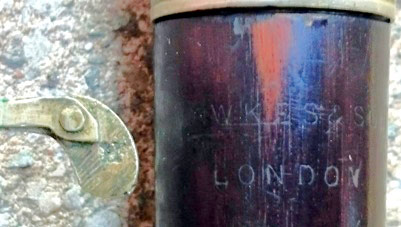
Keys marked H
Jem Hammond reports a key from a Hawkes and Son Bb band flute
with the letter H. |
 |
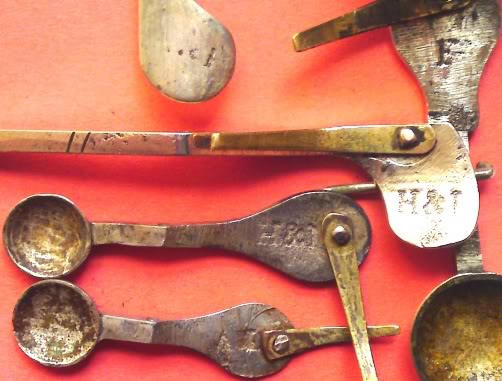
Keys Marked H&L
Jem Hammond reported a Fentum with what appeared
to be H&I stamped on
most of its keys, but F on the Eb key.
Note again the coexistence of numerical and initial
markings.
|
 |
|
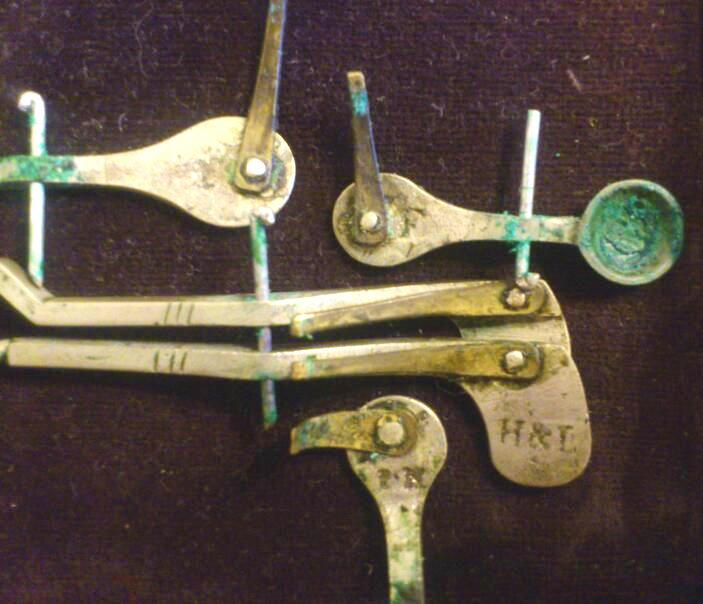
But Jem has come back with more information. Another Fentum shows
that the letters are really H&L. Interesting too the keys on the two
flutes seem to have come from different key-makers. The markings
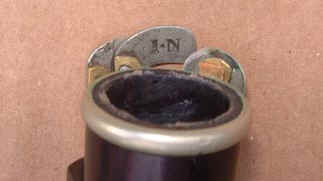
are "F" on the Bb and G# keys, "H&L" on the low C# and "I.N" on the
short F. In the previous set, the F was on the Eb key.
We can also see "///" workshop slashes on the foot key shanks. |
 |
So, who fits the initials H&L? Possibilities would
have to include Haite & Leach, listed briefly between 1852 and 1855 as
woodwind and brass instrument makers. They seem mostly involved
with clarinets, but may have had a less public life in keymaking.
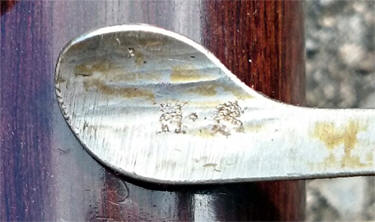
Keys marked H S or H·S
Jem Hammond reports finding keys crudely marked H S on both a Hawkes & Son
and a Butler flute.
|
 |
Keys marked "I·F"
|
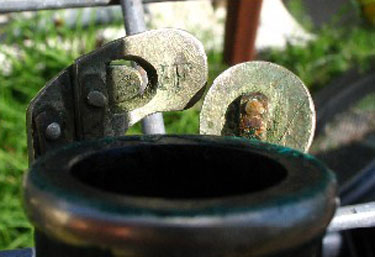
Once again a mark under the C# foot key, once more
the period up at waist level like a decimal point. Daryl King
provided us with the image shown.
Is it possible that this is a fuller version of the
"F" discussed above?
Again the I could be a J. There are no London
flutemakers with initials I.F., but there are a few with J.F. |
 |
| Flute Brand |
Owned/Reported by: |
| Blackman |
Daryl King |
Keys marked IH
Nobody has supplied any images of IH markings yet, but we
should be on the lookout for them. Reputed (in the NLI) to be the
mark for John Hale, London, 1785-1804, which puts him considerably
earlier than most of the flutemakers we deal with in this site.
Montreal maker Boaz Berney reports seeing IH on flutes
by Cahusac and Collier, and quotes Ardal Powell in regard to flutes
marked Florio and Gedney. The IH mark is allegedly
found on flutes by Astor, Kusder, G. Miller, Proser,
while Hale's own flutes were sold by Goulding & Co.
Keys marked "I·N"
The New Langwill Index doesn't list any maker that fits
into the initials I.N. - a plausible suggestion is that I.N. was a
silversmith keymaker and not a flute maker. "I" often
stands for "J" - eg the mark I·HALE for John Hale - but still
no one obvious with those initials.
It may occur to you that it could be
N·I
rather than I·N, however
note that the letter N in
Times Roman has no seraph at the bottom of the oblique line.
Ciarán Somers reports the example below, on a flute stamped
"George & Manby". Again, the NLI makes no reference to
George or Manby. Ciarán reports having seen the inscription on
flutes by Rudall & Rose, and seeing a Rudall & Rose also stamped
George & Manby. It is possible that they were a music dealership
in Fleet Street.
| Flute Brand |
Owned / Reported by: |
| Fentum |
Jon Cochrane |
| Fentum |
Jem Hammond |
| George & Manby |
Ciarán Somers |
| George & Manby |
Ebay sale / Jem Hammond |
| Rudall & Rose |
Ciarán Somers |
| Rudall & Rose |
Chris Wilkes |
| Wylde |
Pamela Carr |
| Wylde |
Chris Wilkes |
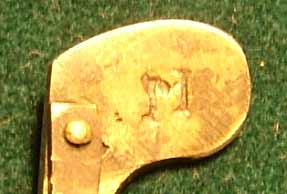
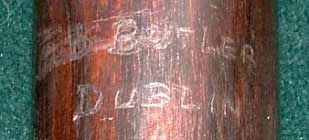
Keys marked M
This C# key touch bears a neatly marked M - the flute
itself marked Butler, Dublin, but in a curiously unsophisticated
manner! Thanks to Lawrence Mallette.
Keys marked N
Only one reported so far. Jem Hammond advises:
Paine & Hopkins 9-key (B foot) concert flute #54 (Flute stamped
"Paine & Hopkins, 69 Cornmill, London" - P&H were music publishers and flute
dealers, not clear if actual makers, and at that address 1821-37) - "N" on long
C key - only stamped key.

Keys marked "R" or "RR"
Rudall & Rose were the most prestigious makers in the
first half of the 19th century. In most cases, as far as we know,
the underside of their keys were not marked.
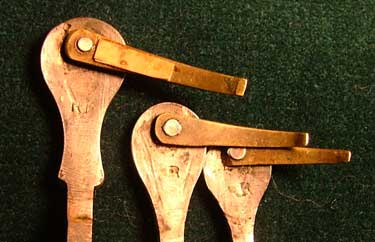
I'm indebted to Lawrence Mallette for the image shown of
the underside of three keys from his RR no 4256. Assuming the same
stamp was used for each (but not totally successfully aligned) the stamp
is RR. Jem Hammond also reports a Rudall Rose flute with
keys marked in a single R, but possibly preceded by another letter. |
|
| Flute Brand |
Key Mark |
Owned/Reported by: |
| Rudall & Rose |
RR |
Lawrence Mallette |
| " |
R or ?R |
Jem Hammond |
An interesting question arises - were these:
-
stamped by Rudall & Rose,
-
stamped by an independent key-maker as being for
Rudall & Rose, or
-
stamped by an independent flute-maker as being for
Rudall & Rose?
And, in any case, why were the other keys not similarly
stamped?
Another form of RR?
|
Bob Perron mentions an RR stamp which doesn't sound the
same as the ones above, in two respects:
-
He describes it as "Under 4x magnification, the mark
looks like an offset double-strike of an R, much like the old
Rolls-Royce logo, only much more crowded."
-
Secondly, he describes the flute as: "Apparently of
French manufacture, but sold in England under the dealer's Mark
'Douglas & Co'."
|
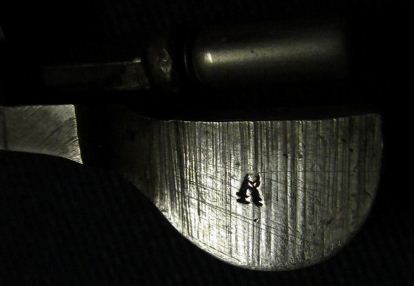 |
Douglas & Co are listed in the NLI as Musical Instrument
dealers in London, late 19th early 20th century.
Keys marked "T"?
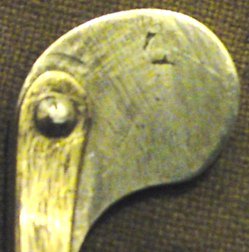
Jem Hammond came across this mark under a key on a flute by
Fentum. Under cross-examination, Jem adds:
"Well, I can't honestly totally rule out it being a scruffy F,
but I don't think what shows matches our known Fs too well. Also I
can see what appears to be the only lightly struck, symmetrical
R-hand half of the top of the T. I wouldn't stake too much on it,
but I think it's worth listing as a ?T with appropriate caveats."
So, be warned!
|
 |
Keys marked "WYLDE"
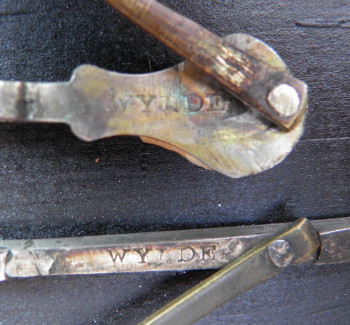
Neatly stamped, image provided by Rob Sharer.
The NLI advises that Henry Wylde flourished London 1832 -
82. He was earlier with Rudall & Rose, and is listed from 1835
as a Flute Maker. |
 |
| Flute Brand |
Owned/Reported by: |
| Pask |
Terry McGee |
| Simpson |
Jem Hammond |
| Wylde / From Rudall and Rose |
Rob Sharer |
So the question here is - did Wylde make the flute or just
the keys? And notice that Wylde appears in the entry on I.N, but
this time as the maker, not the marking!
Flute Key Makers
Were there other flute key makers?
A Google search gives these hits:
-
Lloyd, flute key maker, 2
Broadway, Westminster, (Insurance Policy, 1832)
-
JANE LLOYD: I live at No. 9,
Plumtree-court, my husband is a flute-key maker. (Old Bailey, 1819)
Conceivably the same family as above.
-
Richard ARNOTT b. ca 1803
London (a native of St Lukes, at some point) - had a wife Sarah, when
convicted and transported to Van Diemen's Land (Tasmania) in 1827.
Flute key maker, and later a chairmaker. (From a genealogy site).
-
Mrs Cook. From the
trial of William Camp we glean this
tidbit:----JENKINSON. I am in the employ of Mrs. Cook, of Vauxhall—she
makes silver keys for the prosecutor (Rose) —I made these four keys.
So far, we cannot link any of
these to keys, other than to wonder if C in the Geo Rudall, Willis Fecit
flute could be Mrs Cook. If she made keys for Willis while he was
making Rudall's flutes, Rudall is quite likely to have mentioned her to
Rose when he joined him.
None of these names show up
in the NLI as makers. It is good to establish that flute key
making was an activity carried out in isolation as well as in
association with flute making.
Keymarks used, listed by Flute Brand
Did any flute brands use keys by more than than one
maker? This can best be answered by rejigging the data as in this
table.
|
Flute brand |
Keymarks used by this brand |
| Astor |
IH |
| Barnett Samuel (B&S) |
F |
| Best, G.J. |
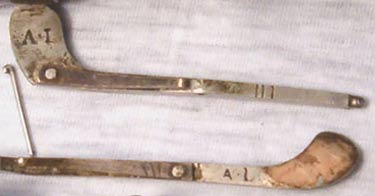
A·L |
| Blackman |
F, I·F |
| Butler |
A·L, M, HS or H·S |
| Cahusac |
IH |
| Clementi |
F, Fs |
| Collier |
IH |
| Douglas & Co |
Overlapping RR |
| Fentum |
F, H&L, I·N,
T(?) |
| Florio |
IH |
| Gedney |
IH |
| Geo Rudall, Willis Fecit |
C |
| George & Manby |
I·N |
| Hawkes & Son |
H S, H |
| Keith Prowse & Co |
A·L |
| Kusder |
IH |
| Liddle |
A·L |
| Miller, G. |
IH |
| Metzler |
A·L |
| Metzler & Co |
A·L |
| Moon (cylindrical 8-key) |
A·L |
| Paine & Hopkins |
N |
| Pask |
WYLDE |
| Proser |
IH |
| Rudall & Rose |
I·N, R, RR, ?R |
| Simpson |
WYLDE |
| Wylde |
F, I·N, WYLDE |
| Unstamped flutes |
A·L, A*L,
F |
I've highlighted flute makers who are reasonably likely
to also have been their own keymakers. Don't rely on that yet
until we see a lot more data.
Note that suddenly we are interested in the keymarks on
unstamped flutes, as, with the rest of the data beginning to fall into
place, it might give us an idea of who made the unstamped flutes.
The question also arises did any of these brands
sometimes have no stamps under the keys? We should note that too.
Hallmarks
I haven't included any Hallmarks in this account, at
least at this stage. We may come back to that if we find useful
examples. Some makers were renowned for them, for example Monzani
& Hill, see Rick
Wilson's Monzani page.
Conclusions
A bit too early to jump to any conclusions - we're going to have to
assemble a lot more data. So pop those pesky keys off your old flute
and look underneath, and let us know what you find. My thanks to
those above who did!
Related pages
Numerical Key
Marks
Alexander Liddle
Back to McGee-Flutes
Home Page
Created: Aug 2004 |