|
"The Author" in question is
Thomas Lindsay, active as a woodwind maker in London between 1825 and
1833. His complete work is "The Elements of Flute
Playing" or, as sometimes abbreviated, "Lindsay's
Elements", published in 1829. I've extracted these notes as
being of particular interest to flute players today. It's mostly
as published, with some minor changes to punctuation, and some paragraph
headings to help you find your way. Thomas Lindsay ....
Introduction
PERHAPS
no instrument has undergone a greater revolution,
within about the last half century, both with respect to its structure, and, the method
of playing it, than the one for which we write for. Although, in the hands
of a skilful performer, a good Flute with additional keys may, in our day, be considered a perfect
instrument at once capable of the delicacies and refinements of Expression, of modulating into every
key throughout all the intricate mazes of harmony and of preserving a
correct intonation in each; yet at the beginning of the era alluded to, the German Flute, with its
one poor key, could only be played tolerably in tune in some few of the easiest modes, and hence the
disrepute in which it was long held by Musicians.
On the One-Key Flute
The single-keyed Flute, indeed, is so miserably imperfect and monotonous, as to
have been long exploded in well-informed society; for excepting the keys
of G and D, with one and two sharps, it is so unequal in tone and execrably out of
tune, as not to be tolerated by an ear accustomed
to better things. But, the convenient portability of the Flute, the absence of the inconvenience
of tuning, and its near approach to the delicious tones of the human voice, have ever been strong arguments in its favour; and it is therefore
not to be wondered at, if the successive improvements of modern times have at last brought it to such
a state of perfection, that even at the expense of the Violin itself, the Flute, as a solo
instrument has now become the prevailing favourite in the polished circles of fashionable life.
On buying a cheap flute
THERE IS NO INDUCEMENT TO
PRACTISE SO GREAT AS THAT OF POSSESSING A REALLY GOOD INSTRUMENT.
By this we
would be understood to mean a Flute from which a round, full, and resonant tone may be elicited, and which shall be
perfectly in tune, throughout the Scale, or at least, as nearly so, as the nature of the instrument will permit. But in opposition to this self-evident proposition, how often do
we see those who are commencing the Flute, going to some Pawnbroker's or common
Sale-shop, of which, unfortunately for the respectable and fair-dealing tradesman, there are too many about
town, and there purchasing what they consider cheap Flutes, but which, in, nineteen cases
out of twenty, are found dear enough with a vengeance, such instruments being for the most part, got
up, like Hodge's Razors, "TO SELL," and not to play! The cheat is generally soon discovered; the buyer finds he
has " paid for his whistle", and endeavours to console himself by observing,
that " although the Flute is certainly a little faulty, yet he bought it
cheap; it will do to begin with; and if he succeeds, he will by-and-bye get a better."
But nothing can be worse imagined than this attempt to
qualify a bad bargain, because the chances of success with an imperfect instrument go very much
against the learner; and the probability is, that after spoiling a naturally good ear, and wasting a great deal of valuable time in the
fruitless effort to play in tune, upon an instrument physically incapable of correct intonation, the Flute is at
last thrown aside in disgust. By such means, - by the prevailing rage
for "cheap" articles, - that which might have proved one of
the most elegant and delightful of recreations is often, for the object
of perhaps a couple of guineas, turned into a source of vexation and disappointment.
It is a fact that no wooden, musical instrument can be expected to prove perfect, unless manufactured from well-seasoned materials; but, in despite of this truth, it is notorious that nine-tenths of those instruments which are daily
exhibited in
the Sale-shop window are made by needy workmen, without credit, who have
neither capital to carry into the market to purchase a stock of
material, a good model to work from, nor yet character as
tradesmen at stake.
The consequence is that a single log of wood is often purchased on one day, is
sawn into lengths the next,
and subsequently turned, bored, mounted with what is called silver, and otherwise
metamorphosed, in the course of the same week, into an apparently
elegant Flute, - but without tone, without intonation, "sans everything," in short, but
external appearance to recommend it.
This Flute, with all its faults and imperfections on its head is then sold to the Pawnbroker, or Salesman, for whatever price it
will fetch, and immediately offered to the public as an instrument of the very first
order, an article of undoubted vertu!
Flute Fraud!
The reader is assured that this
is no fancied or imaginary case, but one of frequent occurrence and it
is only quoted as a caution to the inexperienced. Very few of these work men play
the Flute themselves, and, what is still less credible, many of them do not even blow it:
how, then, we ask, is it to be supposed their instruments can be in tune?
But incapacity is not the whole "head and front of their offending," for these sort of gentry often go a step
further, and having no reputation of their own, they make free to borrow
that of various respectable and established maker's, by stamping their names upon
the trash vamped up in the manner we have described, and so doubly impose upon the
unwary. In this way, the names of Messrs. CLEMENTI
and Co., Messrs. MONZANI
and Co., Mr. NICHOLSON, and Mr.
POTTER have been successively used by the unprincipled and designing, sometimes either omitting, adding, or altering a single letter in the
orthography of the name, so as to evade the operation of the Law, in the event of
the fraud being detected. Indeed to such an extent have these nefarious practices been carried on, with reference to the last mentioned individual, in particular, that they must of necessity have subjected him to much mortification and loss: there is scarcely
in town a shop window of the description alluded to, which has not an abundance
of "Potter's Flutes" exposed for sale, not one in six of which are legitimate, but known amongst the
flute-making trade by the unequivocal denomination of " bastard Potters." The same system has been followed in regard to Mr.
DROUET'S manufacture, and the comparatively inconsiderable number of Flutes, which his short sojourn in this country enabled him to finish, has, even on a moderate computation, been thus surreptitiously increased five-fold, for notwithstanding all
the "fine toned Flutes by Drouet," which are ticketed up in every street, scarcely a
genuine DROUET Flute is now to be met with.
Such, reader, are the tricks and expedients resorted to, to deceive the public; and the inference to be drawn from their exposure, is simple and obvious:
- let Amateurs apply either to a respectable Music Seller, or to a maker of
established celebrity, or else to their Musical Instructor, if they would procure good-toned and well-tuned
instruments.
The Writer's Own Flutes
The publishers are Flute makers, and there are many in the metropolis besides, whose well-earned reputation as manufacturers is sufficiently known to the public, and whose character as honourable tradesmen is an ample guarantee for the goodness of the articles they sell.
On the comparative merits of different makers, the author of course holds his own opinions, but he declines naming any one in particular, from a wish to avoid everything which might be construed by others into invidious imputation, or as originating from interested motives.
[So the Publisher is also a maker,
eh? Let's sneak a look at one of Lindsay's style of flutes.

Cramer, Addison &
Beale's T. Lindsay's Improved
(from the McGee Flutes Research Collection)
We find an elegant 2nd
Generation (post Nicholson) flute in cocus and silver. Medium size
holes, deeply-cupped saltspoon keys and really elegant tone-holes.
Only seven keys, and pewter plugs on C and C#.
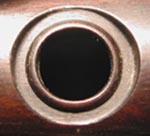 |
So what's so good about these tone-holes? Normally, flutes
with saltspoon keys had funnel-shaped holes for the purse-pads to
find a seal as best they could. But look at the neatness of
the hole at the left. Any kind of pad would feel at home
here! |
But enough with the
voyeurisms. Let's get back to Mr Lindsay himself ...]
On materials:
The question whether EBONY, BOXWOOD, or COCOA, is the best material for producing a fine mellow tone, has been often agitated, and without pretending to decide this point, the author's opinion is certainly in favour of the latter, which, as far as his own experience has enabled him to judge, is most favourable to freedom of
blowing.
On key types:
OF THE VARIOUS DESCRIPTIONS OF KEYS, used by different makers, he gives a very decided preference to those with the Elastic Plugs or padded Keys, not only because
he considers them best adapted for stopping, but also for the powerful recommendation which they carry with them,
- that of being used without noise from the reaction of the key, and the additional fact that they are less liable to get out of order
than either the flat- leathered keys, or those with Metal Plugs, so truly disagreeable for their noise and clatter. The springs of Keys should on no account be too strong; and from the readiness with which the improved DOUBLE SPRINGS are found to act, they are, though a little expensive, entitled to a most decided preference.
How many keys?
In respect to the NUMBER OF KEYS, much may be done
on a four-keyed Flute: but then, the lower C and C
#
being excluded from the Scale, and several considerable advantages of fingering also forfeited, we arrive at the
conclusion that an instrument with fewer than six keys must necessarily be very defective. Now seven keys are doubtless better than six, and eight again preferable to seven; therefore
AN EIGHT-KEYED
FLUTE is what we consider a perfect instrument. The seventh key is desirable for the shake on B, and the eighth, or long F key, is necessary for
slurring pas
sages in the Flat keys, where C, D, or E
b
is succeeded by
F, and which it is scarcely possible to effect without the E being heard between.
The author is aware that this opinion is opposed to a very high authority, no less than to that of Mr.
NICHOLSON himself, mais n'emporte, eight keys certainly constitute a more perfect instrument than seven; for although that great performer has not the eighth key
upon his own Flute, and, it cannot be denied, plays every description of passage in perfection, yet the author has never met with another Flautist who could slur the passages for which the long F key was invented, without using the common cross fingering for the F, and then the note, as everyone knows, is considerably too sharp. The long F key should be made with a shoulder, to ride over or clear the B shake key, whilst the joints are unscrewing: if not so
constructed, these two keys often come in contact when taking the joints asunder, and sometimes spoil the flute.
On the Embouchure:
THE SIZE AND SHAPE OF THE MOUTH-HOLE is a consideration of great importance, because as the natural formation of the lip varies in different
individuals, the same Mouth-hole will not be adapted for every Embouchure. Some will produce a good tone with a moderately-sized
perforation; some with a larger; and others with a small one. The author is of opinion that a moderately-large Mouth- hole inclining to the elliptical form, will in most instances be best adapted for good tone; but the surest way will be to try two different heads to the same instrument with these holes of different sizes. A flute with a very large
Mouth- hole is less easy to play in tune, because, according as the lip covers a large or small portion of it, the pitch will be proportionally flat or sharp, even to the extent of more than a quarter tone.
The slide:
The great advantage of the METAL TUBE in the head joint, for regulating the pitch of the instrument, is so well
known, that no flute should be made without it. The old- fashioned prejudice of its inducing a hard, metallic tone, instead of a soft and mellow one, is nearly exploded, and it is high time that it was quite so.
On hole size:
With the intention of increasing the power of the
instrument, for Orchestral effect, it has latterly become much the fashion to perforate THE HOLES OF FLUTES to a
very large size. By thus enlarging the holes, and attending to those
alterations
consequently necessary in the bore and bearings of
the instrument, to prevent its pitch becoming too sharp, a considerable accession of power has been gained; but the difficulty of playing correctly in
tune - that indispensable of all other requisites - has been much increased, and several notes require altered fingerings. In this principle of enlargement, as in that of fitting Double Springs to the keys, and also in several other improvements of the Flute, Mr.
NICHOLSON was the first to set the example; and although his idea was at first greatly ridiculed, even by those who are now
practically and theoretically its greatest advocates, he was soon followed by a whole race of imitators, with Mr.
RUDALL at the head of the list.
The Writer's Choice:
Now such being the author's notions by which the choice of an instrument ought
to be governed, it follows that HE would fix upon
A COCOA
FLUTE, with eight Silver Cup Keys, to
stop with the Elastic Balls, and fitted with Double Springs; the Mouth-hole rather of the Oval form, moderately large; and a tuning Tube in the
head, as a matter of course. Whether the mountings are of Silver, or Ivory, is a mere
mat ter of fancy; and in regard to the size of the holes, having stated both the advantage and
disadvantage of those of very large dimensions, the Amateur is left to determine for himself.
A good Flute should produce a full, bold, and commanding tone in the lower notes, say C, D and E flat, all three of which should bear
forcing without injuring the quality of Tone: the Scale should of course be equal and well in tune, and care should be observed to have the upper notes, above
D, sufficiently sharp for those of the middle Octave, which
is frequently not the case.
SUCH A FLUTE as we have here described " will discourse most sweetly."
OF THE CARE AND MANAGEMENT OF FLUTES, &c.
THERE are many Amateurs who, although possessed of respectable instruments, seldom play on them, and who, for want of a little care, previous to laying their Flutes aside after blowing, frequently suffer them to get so much out of order from improper treatment, as to become quite unfit for use when again wanted: a few hints to avoid this may, therefore, be acceptable.
Mopping Out
As a good Flute is worth preserving, every Flautist who has any regard for his instrument,
should provide himself, at any Music Shop, with what is called a Mop, or Cleanser,
which is used for the purpose of mopping out the water or condensed breath, that is always left in the tube in
considerable quantities after performance. If the Flute is laid aside without unscrewing and drying, the water will naturally settle in one particular side of the tube; and as it is gradually
imbibed by the wood, the latter will of course expand in that place, and thus have a decided tendency to throw the
instrument out of tune for the moment, and eventually to rot it.
If the Mop is neither applied, nor the joints taken asunder, then the instrument should, at all events, be placed
upright in some corner of the room, so that the water may readily drain off; but on no account should the Flute be put away wet, in a horizontal position.
The Flute Environment
All wind-instruments made of wooden materials are best kept in a Box or Case, and in situations where there is no extreme of heat or cold. Boxwood, Ebony, and Cocoa being all of a hard, brittle nature, particularly the two latter, are apt to fly, when suddenly exposed to any considerable alteration of temperature. In very cold, or frosty weather, for instance, it will
be dangerous to bring a flute out of a very cold room into a warm one, and to play upon it too near the fire; for even the best-seasoned wood will some- times crack on such
occasions, - there is no accounting for it. Nor should a Flute be suffered to lie in a situation where it is exposed to the
rays of the Sun as the author has known several very valuable flutes, although made of
excellently well seasoned materials, either warped or split in this way.
When, by long disuse, an Instrument has become so very dry as not to be playable, it is customary with some people to
immerse it in water; but this is a bad expedient, and certain to injure the flute.
Oiling
To supersede the necessity of recurring to it, we have to remark that, when a flute is about to be laid aside for any considerable length of time, it will be advisable to apply internally a little
Cold-drawn Linseed Oil with a feather, and to repeat this application once in about every 6 or 8 weeks. The inside should be well dried with a
Mop, or by drawing a silk handkerchief, &c. through the joints, before the oiled feather is applied. This oil may be procured at most music shops, and, as regards quantity, should be used very sparingly. Observe, that if the oil is suffered to come in contact with the Leather of the Keys, it will soon have the injurious effect of hardening its surface, and
consequently, in all likelihood, prevent the Keys from perfectly stopping: to avoid this, we recommend a small piece of soft paper, doubled, to be placed under each Key, before the oil is applied.
Lapping
If the JOINTS are loose, take the old thread entirely off and re-lap them: the yellow hemp thread, used by Ladies' Shoemakers, is the best for this purpose. The thread should first be bees-waxed, and then tightly and equally lapped on the
joint till in sufficient quantity to render it perfectly air-tight, when screwed together. Care must be taken,
however, not to make the joint too tight, because, as the wood will occasionally expand in damp weather, or after long blowing upon, the joints will sometimes split by the application of too much strength in
forcing them into the socket. To make the joints work freely, a little pomatum* may be advantageously resorted to; or if that should not be at hand, the substitution of a little Tallow, from a lighted candle, though a less pleasant application, will be found quite as useful.
[*Pomatum:
A perfumed unguent or composition, chiefly used in dressing the hair.
Peterson's magazine
provided these recipes in 1861:
Half an ounce of
white wax; half an ounce of spermaceti; eight ounces of olive oil.
Dissolve in a basin set in hot water before the fire; add some scent just
before pouring into bottles. Or- Get a quarter of a pound of hog's
lard, and three quarters of a tumblerful of olive oil, about a tablespoon
of castor oil, a dessert spoonful of eau-de-cologne, and a pennyworth of
gum; the hog's lard and the oil should be warmed a little, till the hog's
lard melt, then the rest should be put in. It should be allowed to cool
before use. Or- Half a pint of best olive oil, half an ounce of best
yellow beeswax, half an ounce of spermaceti, and about two pennyworth of
any pleasant perfume. Cut the wax and sperm up small, melt in the
oil, and add the scent.]
Key care
The KEYS of all Flutes, no matter of what
construction, or by what maker, will occasionally get out of order, and fail to be air-tight; and when this happens, tone cannot of course be produced. It must, therefore, be desirable for COUNTRY AMATEURS to
receive some directions how to rectify the evil in the readiest way. Gentlemen residing in, or near town,
will always act most wisely by sending their instruments, when out of order, to a maker;
because, by this course, they will, at a trifling expense, avoid all risk of
injuring or spoiling their instruments, and moreover be certain of getting them properly and effectively repaired.
The majority of wind-instruments are fitted with the FLAT LEATHERED KEYS, and when these do not stop, they may be re-leathered after the following manner
:- With any sharp pointed instrument and a small pair of pliers, carefully extract the metal pin which secures the Key to the
wooden knob, and after removing the old leather and cleaning the Key, cut a piece of soft Buck-skin Leather to nearly the
required shape, but larger than the flap of your Key; hold that part of the key that requires new leather over the flame of a candle, till it becomes sufficiently hot to melt all over it a very little of the best
Sealing wax ; then, whilst the wax is hot, quickly apply the leather to the Key: when cold, with a sharp knife cut the edges of the leather to the exact size and shape of the key, and replace it as before. Also, observe to press the key firmly down upon the hole with your thumb, so that an impression of the aperture may be left on the leather. If
Sealing-Wax should happen not to be at
hand, a little good Glue, or indeed any other substance of a powerfully adhesive
nature, may be used instead.
When, after lying long in damp situations; the use of too much oil; or from any other cause, the leather sticks to the wood, gently separate it with a penknife.
Those who use instruments with the ELASTIC PLUG KEYS, if going abroad, or residing at a great distance from any
Flute-maker, should always be provided with a few of the proper Elastic Balls, which they will experience no
difficulty in fixing into the hollow cups of this description of key, with a little Sealing-wax, &c., as already directed. These balls, however, are only to be procured from a manufacturer; and as Flute-makers are not to be met with in every part of
the world, it may be useful to know that they may be made of soft kid leather (an old kid glove, for instance, will serve in case of need,) tightly stuffed with wool, and then drawn together with a needle and thread, in the form of a round ball.
The only directions which we can venture to give, in reference to the METAL PLUG
KEYS, is that they should be kept perfectly clean and free from dust, and occasionally slightly touched with a very little oil; if more is required, the maker
must be consulted.
[Flat Leathered
Keys were the style of key fitted to the baroque or one-key flute -
simply a flap of smooth leather under the flat metal key. Elastic
Plug Keys are what we now call saltspoon keys, and were fitted with
purse-pads - pads simply made by filling a tiny leather bag with
wool. Metal Plug Keys are what we call Pewter Plugs, once
fitted to all the keys of a flute, but later used only for the
open-standing keys C & C#. The shapeless Elastic Balls were not
workable on open-standing keys.]
The springs
Sometimes after a fall, or from the effect of pressure, or some other accident, THE SPRINGS will get so weakened that the keys will not stop closely; this will be best remedied by applying to the nearest watchmaker, who, after taking off
the key, will easily strengthen the spring by very slightly increasing its bend. If the end of the spring is touched with a little tallow-grease, before replacing the key, it will work more freely.
It is scarcely necessary to repeat, that the author only intends the foregoing remarks for the government of those who, from some cause or other, cannot avail themselves of the services of a proper workman:-
to such, he has no doubt the directions here given will prove extremely useful.
I hope you have enjoyed
these words of wisdom from Thomas Lindsay. We hope we can bring you
more from this colourful and knowledgeable writer.
Rick Wilson has published Lindsay's
Fingering chart for 8-key flute.
Pendragon Press has since published
Lindsay's Elements of Flute-playing (1828-30) : A Study in Performance
Practice, with
contributions by Ardal Powell
and Rick Wilson.
Back to McGee Flutes home page
|