Introduction
Perhaps the Rudall and Rose original that is most well known world-wide today
is
the boxwood instrument, No 742, owned and played by Chris Norman. I've had the pleasure of being in their company - I should
share it with you.
I caught up with No 742 at Boxwood, Chris Norman's wonderful wooden flute
festival held each year in Lunenberg, Nova Scotia. Chris
invited me to be a maker-in-residence in 2002. I jumped at the offer and
had a ball! Go there, at least once in your life. Do it
soon!
Chris left the instrument in my care as he went off to teach
classes. I'd already
spend some time poring over the dimensions of the flute, but it was nice
to spend some time with the instrument itself. I just hoped the
drool marks wouldn't show.
First impressions
The first thing to notice is that it is of the small-holed variety, more valued for refinement
than power. My Rudall, Rose or Carte
Models Study reveals that this was one of the company's most popular
lines. This is interesting as it has as much in common with the earlier
small hole 8-keys as it does with the large-holed instruments we expect of this
period.
We can also approximately date the instrument - the Study suggests that No
742 would have been made some time around 1828.
The flute itself
As you can see, it's a lovely instrument, in unstained boxwood and silver:

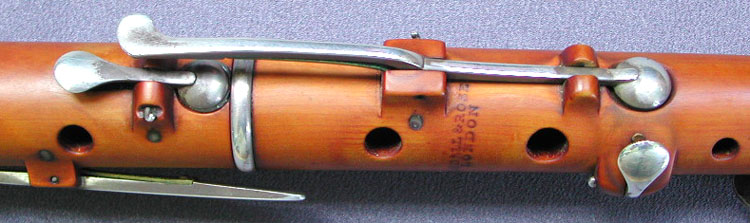
A closer look (below) shows:
- the long F key is rotated more than the G# to give better access
to both, a thoughtful feature dropped for some reason in some later
flutes
- the long c key is straight, rather than the hockey-stick shape
that we expect in later instruments
- springs mount straight onto the shafts, rather than onto little
platforms as you see on later Rudall
instruments
- cork dot silencers under the short keys (eg. under the Short F
key)
- the axle blocks have steel pins though their bases, presumably
intended as a strengthening device
- the challenge of squeezing in the G# key-cup above the tenon is
well illustrated
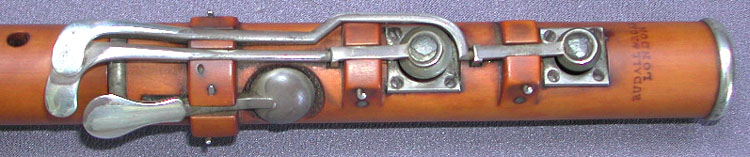
A close look at the foot reveals:
- the steel pins in the hinge blocks again
- pewter plugs on C and C#
- plenty of room on this long foot for the C and C# key touch shafts
- overlapping hockey-stick touches on C and C#, but without the
rebates and finger-joint to facilitate sliding found on later
instruments.
Ok, so enough of the drooling. Let's get down to tintacks .... |
So how's the tuning?
Like any early 2nd generation 8-key, you've got to expect some
quirks. And yes, we found them, but not too bad really.
As usual, the most noticeable quirk is the seemingly inevitable flat
foot syndrome. Note in the chart below how low C, C#, D and Eb are far flatter
than most of the body notes. Note too how that flatness is
reflected in the octaves of D and Eb. Note also the old recurring
pattern - C# and Eb are the flattest notes, D less so and C the least.
But still, it's not as bad as many early 8-keys, and we'll come back
to the reason why.

There are some other rather flat notes too - what about them?
Let's work our way up from the bottom:
- F# is always a little flat on an 8-key, because we simply
can't stretch enough to get far enough away from E. It's bound
to be worse in a medium small hole flute, as the F# hole is not as
big. You can
live with 10 cents though.
- G here is probably flat because it's a bit small and F# is flat -
a bit more venting here would be handy, but then it would be a
medium holed flute!
- G# and Bb are flat for two interesting reasons. Firstly, the
keyholes are a bit on the small side - this was common in the early
days. But secondly, this particular flute has pads that are a
little overstuffed, and cork buffers that limit the key opening a
little too much.
- When we move to the second octave, we generally see the same
effects repeated and in some cases amplified.
|
Why is it so?
Let's look at the venting of this flute with a view to explaining
some of the tuning issues (see Interpreting
Venting Charts for an explanation of the format).
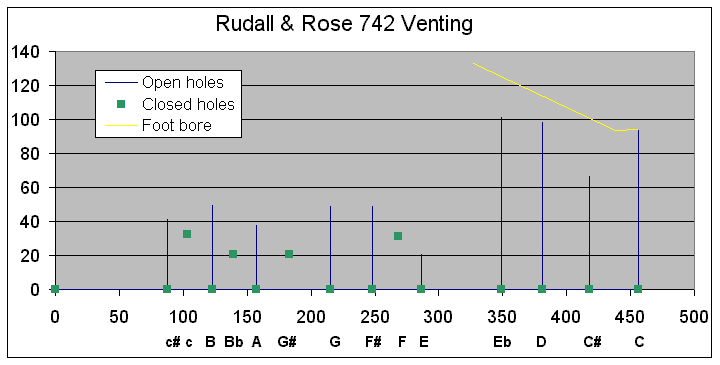
Things to notice:
- how small all the body holes are compared to other flutes we've
looked at, and compared to the foot notes
- how much smaller the key holes in the body (c, Bb, G# and F) are
compared with the open holes. We get away with c and F, but
the smaller holes are just a bit too small.
- the big gap between E (at 280mm) and Eb (at
(350mm) (almost double the other semitone intervals). There's our
flat foot.
- while the foot notes are well distributed, note how the C# is
distinctly smaller. No wonder it's one of the flattest notes.
But not too flat?
I said we'd come back to the matter of flat, but not too flat,
feet. Here's an interesting observation.
When Nicholson the Elder took to the holes of an Astor small hole
flute with a sharp instrument and an evil grin, he ushered in the large
hole era. This brought greater power, and the promise of better
intonation, but that promise was not immediately realised. Indeed,
the immediate outcome was that things got worse, and for a very simple
reason. Enlarging the body holes but doing nothing with the foot will sharpen the body notes,
increasing the pitch gap between the body and foot notes. We
interpret that as "flat foot syndrome", but it might be fairer and more
illuminating to call it "sharp body notes syndrome".
Enlarging, and therefore sharpening, the body notes should be
accompanied by a shortening, and therefore sharpening, of the foot, and
a lengthening, and therefore flattening, of the head. Looking at
my Rudall Rose or Carte Models
Study suggests that this was not done, at least, not for many many
years, and then only gradually. So while the larger hole
flutes would have enjoyed better body note intonation, they would have
suffered more from flat foot syndrome. Such is life.
|
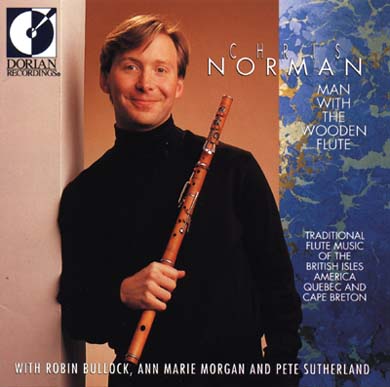
Getting to hear that flute
By this stage, you may well be asking when do I get to hear this
flute? Well, if you don't already have the album, here's what to
look out for. And there's that flute.
If you're a wooden flute enthusiast, do yourself a favour:
For
this, and rather a lot more from Chris Norman
|
 |
Looking after history
Chris is aware that # 742 had already enjoyed a long and probably
busy life before it reached him, and it might be too much to ask it to
be the workhorse of such a busy professional musician. So he had Californian
maker Rod Cameron make him a copy, in blackwood, for workaday purposes.
No 742, if you like, has been put out to stud. Not entirely
though, Chris reports that he has been playing it a bit more lately for
local concerts and recordings. And it's on the new CD, The
Caledonian Flute, for a number of selections.
I also make a version of that model, my "Rudall Refined",
based on RR #5047 in Edinburgh. The main differences between the
two are the shortened foot, discussed above, and the materials - 5047 is
in cocuswood, boxwood being somewhat out of fashion by then. RR#
5047 would have been made around 1845, 17 years later. The foot is
8mm shorter, substantially reducing flat foot syndrome.
Acknowledgments
I am indebted to Chris Norman and Rod Cameron for
making the instrument and dimensions available for this study. And to
Rudall & Rose, for making instruments that still command our
attention, 175 years later.
The Last Word
The last word go to Chris himself: "I'm pleased that you
feel as I do, that it's a magnificent instrument. It really is one
of the best ones I've come across - with a truly magical voice."
Back to McGee Flutes
Index Page
|
|