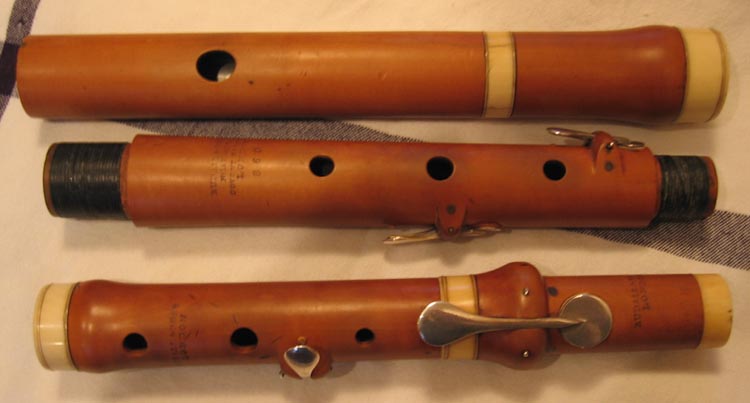
Some Unusual RudallsIn this page, I'm going to introduce you to some unusual flutes and some unusual features I've come across in my studies of the work of Rudall, Rose and Carte in their various combinations. Some of the things we'll see will include a French style 5-key in F, an all-ivory flute, a short D foot, a Bb foot, a 13-key, a Brille mechanism, a one piece body, duplicate Bb keys, post mounted keys, a flute with reverse tenons, a flute with all pewter plugs, and one with flat plate keys. It could take me some time to get all this together, so enjoy what's here for now and come back often! A French-style Rudall in F!Here's an intriguing flute in ebony (or perhaps blackwood?), marked 1916, made by Rudall Carte & Co. Ltd., London, England. Nothing unusual about that surely, but wait ... By the time Rudall & Rose changed to Rudall Carte & Co in 1872, their 8-key style flutes were up to serial numbers in the 6700 region. And even then it wasn't a "Ltd" company - according to the New Langwill Index, that didn't happen until 1911! By then, they were well above 7000. But this flute is No 1916 .... |
|
A few interesting features:
|
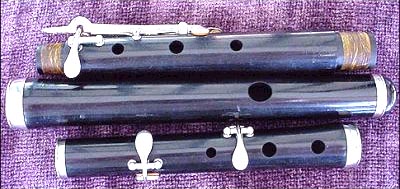 |
| I guess we can assume it's a band flute (key
of F, no slide, integral short foot, high pitch) and that these had
their own numerical series. Unless of course, 1916 is the year
....
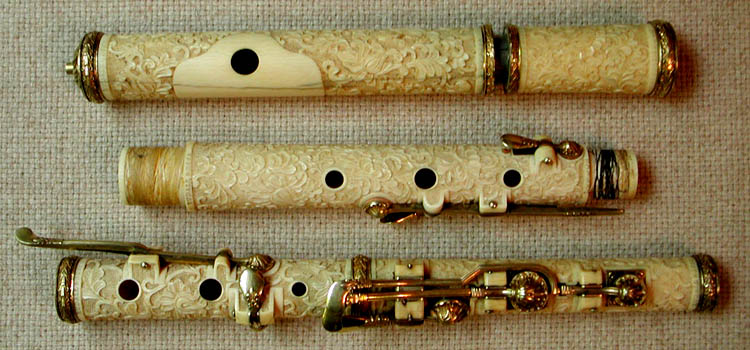
My thanks to owner and player M. Pettengill for bringing this interesting one to our attention. If you've seen anything like it, of course, we need to know! Postscript: Peter Challans advises he also has an identical flute with the same number, supporting the suggestion that 1916 is the year rather than a serial number. 1915 or 1917 anyone? An All-Ivory RudallThis exotic instrument is made totally in ivory, engraved in a floral pattern. As you can see, the keys and rings are in the Acanthus leaf style and are gilded. Not really much more you could do with it, is there?
An interesting point is that the flute appears to carry no serial number. This is most unusual for Rudall & Rose, and would usually be regarded as a possible sign of a fake (Check out a real fake here!) There is a full address though (not normally given on a fake - why help your customer draw attention to your activities?). It also would seem unlikely that anyone who could achieve the kind of workmanship shown above would be in the faking game. Special thanks to Helen Valenza for making this and other flutes available for our study and admiration. A 13-key RudallWhile 8-keys were generally enough for the typical British player, players in Germany and Austria often lusted for more. Occasionally, no doubt, a player used to such a flute would have asked for something similar from the old firm. It seems they never passed up a challenge...
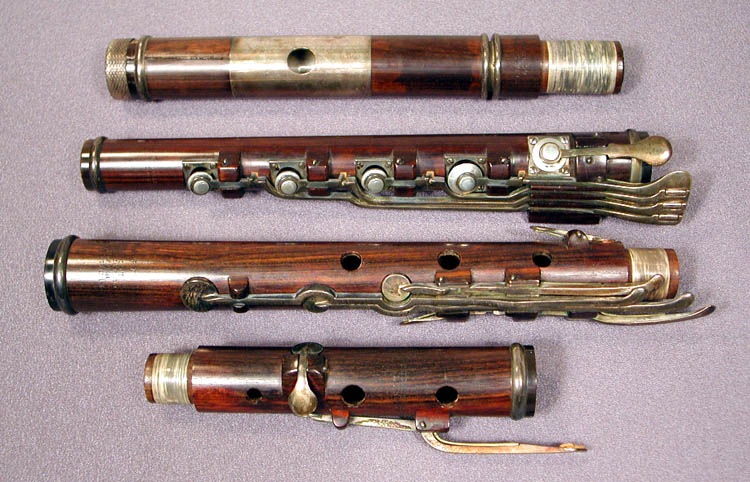
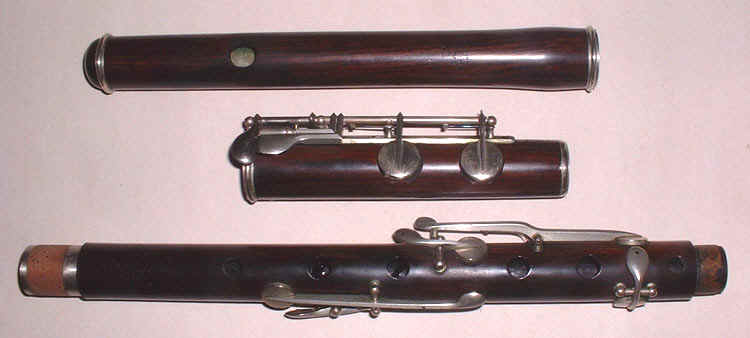
Rudall & Rose No 1959, 13 keys, DCM 440. From the top, the keys (and fingers to operate them) are:
Note a few other unusual things:
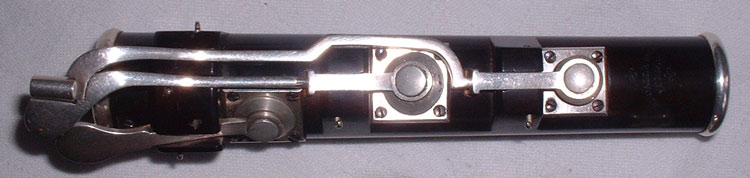
Rudall with D and Bb feetNow your typical 8-key flute has a C foot, but the flute above went down to Bb, and that amounts to a lot of hardware. The French version at the top of the page just went down to D. Can you have your cake and eat it too? With this company, yes.
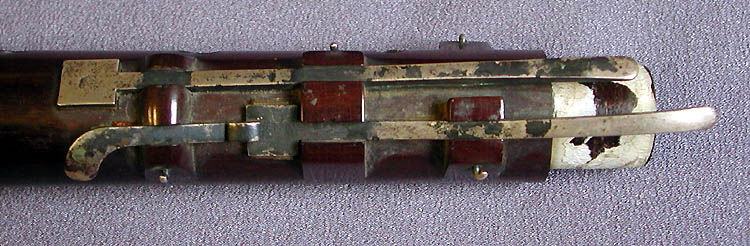
Rudall & Rose No 2602, with interchangeable D and Bb feet. DCM 22F Rudall with square keysSquare flat keys were a feature of flutes from the baroque period, but had generally given way to saltspoon and pewter plug keys by Rudall & Rose's time. But yet ...
R&R No 4482 - detail of Bb and C keys. Horniman Museum, London A Rudall 4-keyWe tend to expect 8 keys or more from flutes in the 1830's, but here's your late-18th century stalwart, the 4-key flute, showing up in Rudall form. Essentially similar to Chris Norman's RR # 742, but with a short D foot rather than the C foot we'd normally expect. No doubt quite a bit cheaper, but still fully chromatic from D upwards. Why not?
This one, RR # 860, has lost its cap making it look even shorter. Image courtesy of English researcher and collector, Simon Waters. A cylindrical 8-key RudallAfter Boehm brought out his 1847 cylindrical, many, obviously including Rudall & Carte, applied the new bore to the old 8-key. This one, No 7295, is interesting in that it also has the new foot arrangement. It's in a private collection in the UK.
Note the offset and asymmetrical G# key (depressingly pre-emptive of the McG# Bent & Twisted key I thought I had invented in the 1990's). It's generally argued that these anachronistic flutes were the pathetic rump of a dead tradition, yet there's still signs of someone caring. A military band flute in BbLike other makers at the height of the Empire, Rudall & Carte found a ready market for military band instruments. This little Bb flute (sometimes called a fife) was typical, and would have set you back a mere £1 .6s. While we think of boxwood and ivory as exotic and luxurious materials, they were reserved for the cheapest grade of instruments in the mid and late 19th century.
Marked: Rudall Rose & Carte / 20 Charing Cross Road / London, this is in a private collection in the UK Rudall with a roller footkeyProbably confirming the notion that Rudall & Rose would make anything you asked them for, here is a c-key with roller.
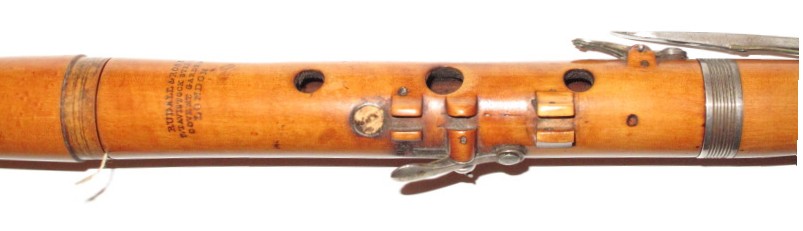
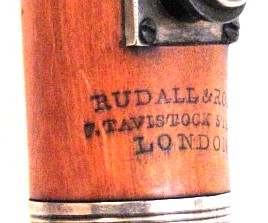
Another from a private collector, UK Rudall with pewter plugsWe normally associate flutes with pewter plugs on all keys with the earlier makers Richard or William Henry Potter. But here's a flute with the Rudall & Rose address block with all pewter plugs. You can see the silver receiver tube buried in the wood where the missing C key should be. Note also that there are three blocks for the C key - the hinge block on the right, the usual Bb hinge/C guide block in the middle and an extra guide near the hole. Perhaps they were concerned that a long pewter plug key would need closer guidance than is normally provided by the Bb hinge block? Note that the LH guide block has the characteristic reinforcement pin through it, just above the surface level of the rest of the flute. The C hinge block appears to be a replacement but appears to also have had the reinforcement pin, as does the G# block on right of image. The hole out in the open to the right of the missing C key was for the cork dot silencer.
I'm also puzzled by the address, which looks to me to say 7 Tavistock Street, London. The usual bible of woodwind history, the New Langwill Index, gives the possible Tavistock St. addresses for Rudall & Rose as numbers 1 and 11. This image is from the foot; the address on the LH section appears the same. My thanks to Dave Burley for the images. All I have time for at the moment, I'm sorry. I'll bring you some more Rudall Oddities as time permits! Back to McGee Flutes home page...
|
|


 Note
also the lack of a serial number, something rarely seen in flutes marked
Rudall & Rose.
Note
also the lack of a serial number, something rarely seen in flutes marked
Rudall & Rose.