Introduction, Plan A
After formulating some plans
which we hoped might help restore our strangled boxwood flute to better
health, we found ourselves unable to put the simplest plan, Plan A, into
operation. The plan called for just playing the flute, but the
flute was not yet playable. It was missing keys, it was cracked
through the barrel and into some of the sockets, it had dodgy brass
rings that are probably crushing the bore near the sockets - this thing
is a basket case! So, we put Plan B into operation first, and
learnt some rather startling things. While that was happening, I
did some hasty repairs to the flute so we could revert to Plan A.
The Repairs
The repairs were minimalist.
Not because I was lazy or impatient, but because I didn't want them to
impact on the experiment in hand. For example, if I replaced the
dodgy brass rings that appeared to be crushing the RH and Foot sockets
with something permanent and nicer, their presence would prevent any
hope of the sockets being restored to their original size. Better
to try to limp by without the rings, than compromise our quest. So
what did I do?
I elected to just leave the
dodgy brass rings off, and support the weak socket wood by wrapping them
firmly with string when I wanted to play the flute. I now have a
lot of faith in the constraining power of string!
The head was easy. All
it needed was a new stopper, so it got one.
The barrel was also
straightforward. Because of the crack through it, it was leaking
like a sieve and certainly rendered the flute unplayable all by itself.
But the barrel, being lined, is not going to play a big role in this
experiment, as its bore dimensions are defined by metal, not wood.
So, I felt free to do the usual repair - remove the slide, glue the
crack, rebore and reinstall the slide.
I had harboured hopes that I
could get a more accurate reading of how much the barrel wood had
shrunk, after I glued the crack shut but before reboring. But the
old bore was so distorted, I could have had my pick of readings.
Not unusual - I've tried that before with the same results.
The cracks in sockets I dealt
with simply by injecting superglue. I figured I could always get
that off if necessary, and that I could review the success of the glue
when I came to putting nicer rings on later. If the flute survived
that long!
I got around the leaky and
missing keys by simply leaving all the keys off, and plugging the holes
with poster putty when I wanted to play. That limited me to
playing diatonically, but that's fine - all we want is my damp breath
coursing through the instrument. But I felt it was important that
I should be able to play up and down the scale - to close all the holes
and just play D wouldn't be realistic.
I did find that I had to make
sure the putty covered right over the pewter plug inserts, as more than
one of them were leaking around the insert. Take note, restorers!
I also found I had to plug a
small knot on the back of the LH section that had been filled with resin
back when the flute was made. Seems the resin had shrunk more than
the wood, or perhaps Plan B's excessive re-hydration had loosened it.
It took me some time to find it - the Magnahelic Flute Leakage Detector
told me I had a problem, but not where to look.
Finally, I had to deal with
the question of tenon lapping. Because I had hopes that the tenons
might be able to be un-strangled, I didn't want to do anything
semi-permanent, like cork, which might then have to be undone. But
I clearly couldn't properly thread-wrap them either - that's how the
poor flute got strangled in the first place. So I opted for
temporary thread wrapping. I used some quite thick thread which
went on quickly, and came off equally fast. The thread would only
be on for the playing time, and even then I made sure to wind it on
loosely. Being thick and squishy, a single layer was all that was
needed. When off the flute, I wound the three lengths of threads
on to a short length of dowel, marked H and F at the ends, to make it
easy to know which thread went where.
After all that, I had a flute
that worked, well sort of. It was rather sullen - more of a dead
stick than a vibrant flute. And it still looked pretty miserable.
This was a patch-job, not a restoration. That might come later.
What, no oil?
One thing I did decide
against was oiling the flute. A bit cruel, given it probably
hadn't been played or oiled for 100 years or more. But I'm trying
to produce change, not trying to avoid it, and oiling the flute would
have rendered it harder to influence. Later, I promised. I
also promised to take it slow and easy.
Indeed, it occurred to me,
this is where we can actually test our advice on "blowing flutes
in".
Plan A
You'll remember Plan A was:
subject it to some
normal playing, to see if, freed from its tenon wrapping
constrictions, we see it starting to move spontaneously towards one
of the shapes we predicted in the previous articles.
More of a mission statement
than a plan, isn't it. It needs flesh. What are we actually
going to do?
Moved by the notion that we
can also use this experiment to test some of our advice to players about
"blowing in" a new flute, I decided to make the experiment as real as
practical. This meant:
-
the instrument would live
in a hardwood wooden box, lined with cloth, pretty much like the
19th century mahogany cases.
-
the instrument would only
come out to be played. After playing it would be mopped out,
and the flute and the mop would go back into the closed box until
next time.
-
I would measure the
weight of each section of the flute before playing, after playing
and after mopping. I'd also monitor the weight of the rag. I
would use scales with a resolution of 0.01gms, and I'd zero and
calibrate the scales against its calibration weight each time,
-
I would use a datalogger,
set to take a measurement every 5 minutes, to monitor temperature
and relative humidity in the case,
-
I'd aim to play 10
minutes the first day, 20 minutes the second, and so on, until I
reached some obvious point of conclusion,
-
I would graph the
results, subtracting the original weight of each section, so we
could see how much water it took on, where the water went, and how
long it stayed around.
-
I gave the flute a few
days in the box to stabilise before starting the experiment.
The same measurements detailed above confirmed that the flute and
box had equilibrated.
And the results?
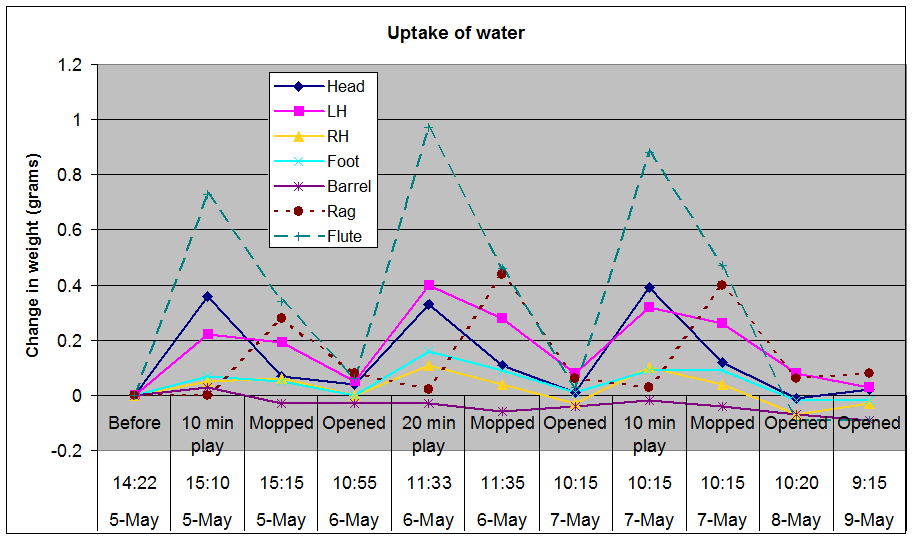
The results are shown in the
graph below, and I'll walk you through them to make sure you get the
full picture.
Firstly, the vertical scale
shows the weight gain, in grams. Good to remember that 1 gm of
water is also a millilitre, or a cubic centimetre. So, visualise
the 1 gm line as an ice playing dice.
The horizontal scale shows
the status, plus the date and time.
Each section of the flute has
its own coloured trace, in solid. The colour code is given in the
legend in the graph. The overall weight of the flute is shown in
dark green dashed, and the rag in brown dotted. Let's follow the
action....
Day 1 - 5 May
"Before", 5 May, is our
reference point, so everything is defined as zero.
I played for 10 minutes and
took readings. You can see that the whole flute gained just over
0.7gms, or mL. That's not a lot of water! Most of it is in
the head, and most of the rest is in the LH section. Negligible
amounts made it to the RH and foot sections.
Then I mopped out, starting
at the head, then barrel, LH, RH and Foot. The rag was a bit of
T-shirt material, chosen so that it would just pass through the foot,
with the stick reversed, and used as a pull-through. The stick was
used as a push rod for the head and barrel.
Note that logic actually
suggests we should mop out the foot first, and then make our way up the
body, and do the head last. This would reduce the likelihood of
distributing the head moisture throughout the rest of the body.
But I wonder who thinks to do that? Don't we all go for the wet
bit first? Because I'm looking for change, I didn't do it either,
but I should test that theory too sometime!
(Hmmm, notice that every time
we embark on one of these experiments, we end up flagging a few more
experiments that are needed!)
Note that the mopping-out
slightly more than halved the moisture in the flute, leaving the flute
and the rag about equally moist. It dramatically lowered the
moisture in the head , but only reduced the LH moisture a little,
possibly because of redistribution of head moisture, or possibly because
it's easier to dry metal than wood, or maybe just because a wet rag now
won't dry anything else. Alternatively, maybe that moisture had
already largely soaked into the wood of the unoiled LH section.
Day 2 - 6 May
As you can see, when I opened
the box the next day and ran the measurements, pretty much all
yesterday's moisture had disappeared, probably absorbed into the wood
and fabric lining of the box.
This day, I played for 20
minutes. I noticed though that in that time some moisture had run
down the flute and dripped from the end, and the temporary thread
wrapping around the upper tenon was also wet. Sure enough, we see
that borne out in the next set of measurements, "20 min play". The
measurements record more condensation than the 10 minute play, but not
double that amount. The various measurements more-or-less reflect
the same pattern we saw after the earlier playing, although more of the
moisture can be seen to have made it into the body and foot. The
head actually retained less moisture, probably because the moisture had
become mobile. So, clearly, I had run into a turning point already, one
where the moisture is no longer retained in the bore. If it's not
there, I can't measure it. And if it's not there, it can't
influence the moisture content of the flute wood.
Day 3 - 7 May
Once more, the next day,
almost all the moisture gained had disappeared. Playing flute
might be fun, but it isn't the most efficient way to pump water.
I had planned for a 30 minute
playing time today, but doubts were rising in my mind. Even at 20
minutes playing time, the water had started to escape the flute, making
it 1) ineffectual in increasing the flute's moisture content, and 2)
unavailable for measuring. But as well, I have to say I wasn't
enjoying playing. I'd picked up a ticklish cough somewhere along
the line, and playing triggered it regularly. I started to wonder
about that mould we had to wipe off in the last article! But as
well, this flute, in its current condition, was simply no fun to play.
I staggered on to 10 minutes, and decided enough was enough. As
you can see from the graph, the third playing cycle produced results
lying between the first and second. Back in the box!
Days 4 and 5.
Next day, I did the usual
readings, and found again that the flute had pretty much reverted to
original weight and measurements. To be absolutely sure, I gave it
another day and found the same. A total of 40 minutes playing
time, and the moisture content was right back to where we started!
So, what did we learn?
Quite a bit, as it turns out.
Some of it is new, some is confirmation of what we probably all have
noticed. But of course it's good to get the confirmation.
I'll replicate the graph here
so you can easily check any points you wish to.
-
a metal lined head
will quickly attract condensation, but, after about 10 minutes
playing, that condensation will start to run down the flute.
-
the LH section of the flute
ends up most moisture affected and is probably the only section at any
risk (in a flute with metal lined head)
-
lower sections are more
affected with longer playing times, but probably mostly because of
run-off, rather than condensation
-
mopping a flute, at least with
old T-shirt material, removes about 1/2 the water that was present after
playing, but is probably helpful in redistributing the remainder, reducing
local swelling and speeding evaporation
-
our measurement methodology holds
up well until the point where water starts leaking from the flute. (But who
cares after that?)
-
this methodology could be used to
compare the efficacy of different mopping materials and tools
-
it may also offer a means by which
the protective effect of different oils could be tested
-
the small amounts of moisture
acquired have been dissipated overnight in a closed wooden box
-
a wooden flute box is shown to be very effective
at buffering temperature and humidity. The data-logger record varied only a
few degrees and a few percentage points of RH over the test period. As
soon as the moisture evaporated from the flute and rag, it was assimilated by the case
and/or
lining
-
the metal-lined barrel appears to
absorbs no moisture, even though some had leaked into the socket
-
it seems very unlikely that just
playing for short periods is going to return our flute to its original shape in
any reasonable amount of time.
-
playing for long periods will subject
the flute to very patchy moisture distribution which may or may not be helpful
in restoring the original dimensions
Plan C -
Simulated playing
So, if real playing is not very effective in wetting a flute uniformly and
easily, can we find another way? What about putting a wet rag
inside for a while. Surely that will work!
So, I found a scrap of rag (T-shirt material - by now you're probably
getting a fairly accurate impression of summer attire in our little
coastal village) that fitted easily in the RH section of the Potter.
I chose the RH section as the LH section was off assisting authorities
in another line of investigation. Anyway, it was still oversized
from our humidification experiment, and I thought it would be
interesting to see if something similar happened to our RH section,
assuming of course we can convince it to take a drink.
I soaked the rag in water, then squeezed it out a little to the
wet-but-not-dripping stage. I threaded it on a cleaning rod, ran
it just through the joint, detached the rod and tamped the loose ends
into the ends of the section. Then, every now and then, I pulled
out the rag and weighed the section, comparing it to its dry weight in the
graph below:
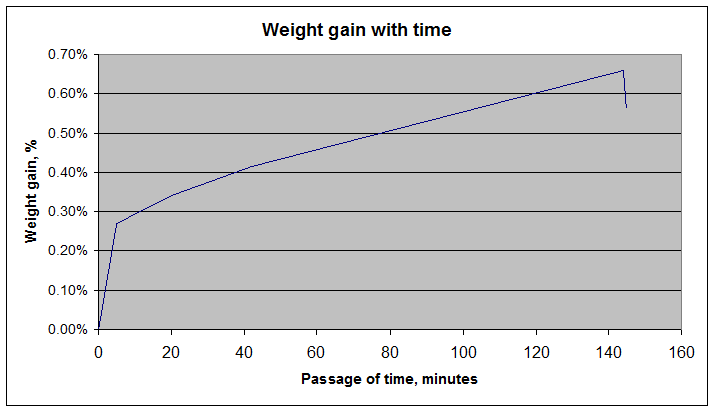
You'll see that, as soon as wetted by the wet rag inside it, it gained
about 0.25% its own weight in water. That water was visible,
glistening on the surface of the bore when the rag was removed.
But even over 2 hours later, it had only gained a further 0.4%, making a
total of 0.65%. At 144 minutes, I terminated the experiment and
mopped the section out. Interesting that I was only able to remove
about 0.1% of the water.
Interesting to compare the efficiencies of the various ways to inject
water:
| Exposure to saturated air |
0.08%/hr |
| Wet rag method |
0.16%/hr |
| Playing |
Depends on which section of the flute |
So, the wet rag method works better for short
periods, but would require to be refilled from time to time.
The saturated air method has the benefit of unattended operation.
Playing is just too haphazard, unless that's the purpose of the
test.
What we haven't tested...
It's just as important to note what we haven't tested here, but really
should at some time:
-
longer playing times (but needs a
flute and flute player in better condition!)
-
flutes without metal liners, or
with partial liners
-
timbers other than boxwood
-
fresh boxwood
-
the effect of various oils in
reducing the rate of water uptake,
-
other mopping materials and tools
-
the difference between mopping
the head out first and mopping the dry end out first
-
when should you keep the moist
rag in with the flute, and when should they travel separately
How come we don't already know all
this?
The wry thought springs to mind - how
come I'm having to "discover" all this stuff, why don't we know it all already?
The flutes we play have been around for hundreds of years, yet where do we find
anything about the effects of moisture on them? We've had the technology -
the beam balance is known to have existed for 4000 years or more.
Certainly, if you can make a flute, making a beam balance is a pushover.
Surely I can't be the first flute maker/researcher in hundreds of years to
wonder just how quickly the water condenses and just where it goes?
Instructions for blowing-in flutes exist, but what informs those instructions -
science, experience or guesswork? Or have we relied on remaining just this
side of disaster, like the reported instruction for tuning a lute:
Tune up thy minnikin (thinnest
string) until it breaketh, then, tuning not quite so high ...
Who should study this stuff?
It also begs the question - who should be
studying this stuff? Most scientific interest in flutes has come from the
acousticians - Benade, Coltman, Fletcher, Nederveen, etc. They can tell
you what the changed dimensions do to the flute, but not how or why it changed
dimensions. It's just not their field. The jet raises some interest
among the aerodynamicists, but again, this has nothing to do with jets.
Organologists, the name for those who study musical instruments, tend to be more
interested in classifying instruments than monitoring their dimensions in use.
We're really looking for wood technologists, but, where they exist among
students of musical instruments, they tend to be seduced by the vibrant
instruments such as the fiddle. That's where the action is; everyone knows
that the wood in flutes is just a box for the air inside. A living, moving
box, as it turns out.
So, what about flutemakers, shouldn't
they be across the technical dynamics of the materials they work in. Sure,
that would be great, but is it practical? Should we all have studied
moisture migration and wood movement in Flutemaking 101? But, even if we
had had the luxury of being formally trained in our profession, who would have
informed the course presenters of what we are measuring here?
So, the writing's on the wall (sorry,
Mr Belshazzar, sir, I promise it won't happen again, sir.) If we want to
understand, really understand what's going on inside our flutes, we'll have to
take a look ourselves. Which is why we are here today. So, get over
it and get on with it!
Conclusion
Well, we certainly learned
some interesting stuff, and we have subjects aplenty for a stack of
other studies. But I think we can ditch Plan A in terms of getting
Mr Potter's poor flute back into condition.
Where to next? I'd have
to say that the question of Hysteresis is weighing on my mind. Did
the LH section move to a higher moisture content and larger dimensions
during Plan B just because of some natural hysteretic effect in wood?
Or did some other change take place during Plan B? I feel an
experiment coming on. Wrong, I feel two experiments coming on...
On to Hysteresis?
or Back to McGee-flutes
Index page...
Created 28 May, 2011
|