For Keyless Flutes (and flutes without an Eb key)
My keyless flutes, and keyed flutes without an Eb key normally come in three pieces. The foot
is integral with the section containing the right hand finger holes, except on
models with long one-piece bodies, such as the Prattens (see below).
The Integral Foot was one of my innovations from way back in the mid 1970's.
It uses the least amount of materials and joints, thus keeping cost and size to
a minimum. It also offers complete control of the lower bore and minimum
obstructions to achieving a bold low D.

Some prefer separate right hand and foot sections instead of the Integral
Foot. Short D and Long D feet for keyless flutes are available at slight
additional prices. They look the same as the feet
pictured below but do not have the Eb key.
The Short D foot is acoustically identical to the Integral Foot; the extra ring to the right of the 6th hole breaks up the bare wood.
The Long D Foot looks like the C foot on the original 19th century
flutes, but has no keys, just the holes where the keys would have been. I
rework the bore of the Long D foot to prevent it weakening the low D as the C
foot can do. It offers a slightly better weight balance than the Short or
Integral Feet, and perhaps looks a little more elegant.
Prattens models have all six finger holes are on the long central section,
and the foot is already separate. So the choice here is between the Long D
Foot or Short D foot.
For Keyed Flutes
If you intend to have an Eb, C# or C key, it is very
desirable that the foot be separate to permit it to rotate for
best access to the foot keys.
There are three foot joint options for keyed flutes:
- the Short D foot, which terminates visually and
acoustically at D.
- the Long D foot, which terminates acoustically at D, but
appears to extend down to C.
- The C foot, which terminates visually and acoustically at C.
D Foot
I recommend a D foot for Irish music (rather than the original C foot), unless you know you
are going to need the low C and C# keys. If space is at a premium (eg cramped
sessions or stage) the short D is ideal. On flutes with a short D foot, I
shorten the head a little to maintain a good weight distribution. Many
prefer the Long D, feeling the extra length is
more visually satisfying and affords a better balance of weight.
I rework the bore of the Long D foot so that it does not weaken
the low D.
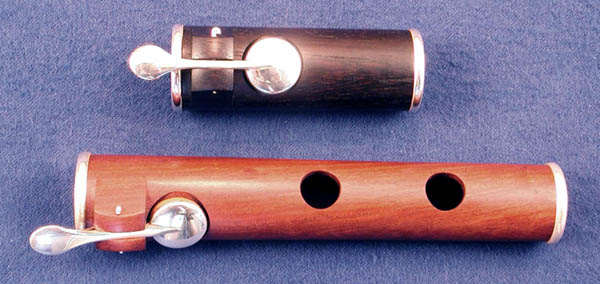
Top: Short D
foot with Eb key. Bottom: Long D foot with Eb key
C Foot
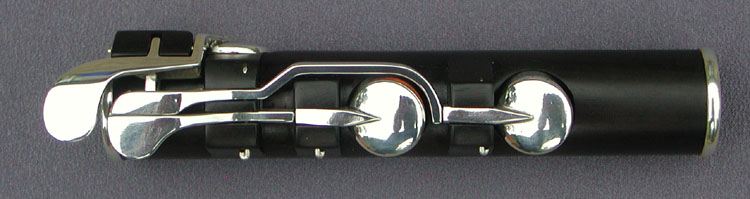
For those who want low C and C#, I make a Revised
C Foot which retains the block-mounted grasshopper-knees keys, but
relocates the touches for far better access.
Now, on to Accessories
Or, back to
McGee Flutes home page...
|