Old Flute Care
This page is about looking after 19th century original flutes. If your
flute is made by Australian maker, Terry McGee , please go to
McGee-flute-care instead. If your
flute is by another modern maker, best to ask them for care instructions.
All woodwind instruments require the same general care. Given that care, there
is no reason why they should not be in perfect playing order in another few hundreds
of year’s time. The rules are simple:
-
Always mop out your flute thoroughly after playing. Otherwise, the
moisture from your breath will soak into the instrument and cause it to
crack or raise corrugations in the bore. Mopping also polishes the bore,
preventing the build up of roughness and ridges that weaken the tone.
-
Prepare a piece of absorbent cloth (old T-shirt material is good) that
will just pass through the narrowest part of the flute. I find a strip
about 250mm (10") long and 75mm (3") wide about right. Attach this to the
end of your cleaning rod.
-
Mop out the foot joint and body sections first, as these tend not to
be so wet. No point in distributing moisture from the headjoint throughout
the rest of the flute! When you mop out the headjoint, fold the cloth back
over the tip of the cleaning stick to get right into the corners near the
stopper. Twist the rod both directions to remove as much water as possible.
-
If your flute has a metal tuning slide, remove the slide from both the
headjoint and body and mop any moisture out from the ends of the tenons
and the insides of the sockets. This is important as the endgrain of wood
soaks moisture up very quickly.
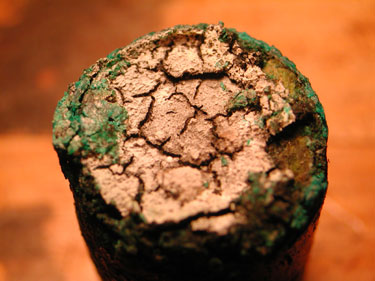
What happens if you don't clean your flute. This cork stopper was taken
from a German flute whose owner admitted he never bothered to clean out after
playing.
The cork of the stopper can be seen as the dark brown patch on the right hand
side. On top of that is a cracked crusty layer of something organic -
probably based on Guinness. On top of that is a vibrant growth which
clearly enjoys the lifestyle. There was more but it came off in the battle
to release the stopper from inside the head. The inside of the head was lined in
similar accretions, the flute now plays considerably better with them gone.
-
Treat a new flute gently. For the first week, limit your playing to sessions
of about ten minutes in duration. Mop out the flute and give it a rest
to dry out for a few hours. Slowly increase length and frequency of playing
over the next few weeks.
- If you're playing for a while, it's a very good idea to mop out
every 30 minutes or so. Preventing the build-up of moisture achieves two
things. The flute is less likely to be damaged and it is easier to play
and sounds better.
-
If possible, leave the instrument's case open after mopping out. This allows
the remaining moisture to evaporate.
-
Never leave the instrument in a hot place, such as a car, mantelpiece or
window sill. This invites cracking.
-
Regularly oil the bore with proper bore oil (not vegetable or machine oils).
I use and recommend LeBlanc's Bor-seal, available from most music stores
or me. Oil the flute each week for the first month, then each month for
the first year. After that, twice a year should be enough.
Prepare a small piece of cloth for oiling your flute. I find a piece
about 75mm (3") by 40mm (1 1/2") useful. You will find that until the cloth
is saturated in oil it tends to rub off as much oil as it applies. For
this reason, I recommend soaking the piece in oil and consequently keeping
it in a small plastic sealable bag. Otherwise you will find your supplies
of oil diminishing quickly and you won't be really sure whether you are
applying enough.
The bore must be quite dry before oiling, and a few hours or preferably
a day should then elapse before the flute is played. Strip the flute down
to its component parts, removing tuning slides and stopper. If you have
keys, either remove them or slip pieces of plastic sheet (or cling wrap)
under the pads to prevent contamination by the oil.
Attach the oily cloth to the end of your cleaning rod (try to minimise
skin contact with bore oil - you don't want your pores sealed). Squirt
a little bit of oil into the bore of the flute and use the cloth to distribute
it uniformly throughout the bore. The bore should glisten with the oil,
but there should be no blobs or runs forming. If the bore doesn't look
wet, add some more oil.
Because endgrain of wood absorbs water so easily, make sure to oil any
endgrain areas where moisture might gather. Examples include the bottom
of the sockets and the ends of the tenons (the parts that plug into the
sockets). If your flute has a metal tuning slide, this applies to the ends
of the tenons that plug into it.
Do this in each section of the flute and set it aside to dry. Pack your
piece of oily cloth away in its bag and store it with the oil. Carefully
reassemble the flute when the oil is dry, remembering to reset the stopper
to the correct position as shown on the other end of the cleaning stick.
-
The outside of the instrument can be oiled with bore oil applied with a
cloth. Buff off any excess oil with a soft cloth. You can also use furniture
polish.
-
Do not leave the instrument assembled for long periods. This compresses
the tenon cork, requiring the cork to be replaced earlier.
-
Use cork grease on the tenon corks as soon as you detect any sign of resistance
when assembling your flute. Keep the cork grease with the flute so that
it's always available.
For best results, massage the grease into the cork with your fingers.
Grease the inside of the socket too. If resistance persists, seek attention
from the maker as the socket wood might have swollen and could jam.
-
If a joint becomes loose, have the cork replaced by the maker or a qualified
woodwind repairer. As an interim measure, you can wrap some waxed dental
floss around the joint. Do not use cotton thread as this can swell with
moisture and jam the joint.
-
If a joint jams, do not attempt to force it. Leave it for a few days without
playing. The swelling should go down. If jamming persists, seek attention
from the maker.
-
The rings on the flute sockets are not just decoration - they are vital
to preventing the thin socket wood from splitting. If a ring comes loose,
do not assemble the flute, but seek attention from the maker or a qualified
woodwind repairer.
-
Dirt building up inside tone and embouchure holes can affect tuning and
tone. Do not use anything harder than soft wood to remove it. Be especially
careful of damaging the edge of the embouchure hole.
-
Be careful while cleaning or oiling not to damage or dislodge the cork
stopper in the head-joint. You can check the position of the stopper by
inserting the cleaning rod up the head-joint backwards. With it touching
the face of the stopper, the mark engraved near its end should appear centrally
in the embouchure hole. (This assumes that your cleaning rod is calibrated
for a conical flute and not a modern cylindrical flute. The mark should
be 19 mm from the end of the rod.)
|