Introduction
Flutes can be made, like recorders, without a tuning
slide.
The small amount of tuning which is necessary can usually be
accomplished by withdrawing the headjoint slightly at the first
tenon. Tuning slides are handy however:
- you have a wider range of tuning available to cater for hot
or cold venues, moist and dry days, players who play further into or
further over the embouchure hole, errantly tuned pianos in pubs, sharp
Uillean pipes, etc.
- adjustments to pitch can be made more easily on the run, as
the slide, when working properly, is very smooth in operation. This
contrasts with the alternative, pulling the headjoint out at the first
cork-lapped joint, which tends to be more "grabby".
- pulling out the slide produces only a minor variation (5%)
in bore diameter at that point, compared with the larger discontinuity
(24%) produced by pulling out at the socket. This brings benefits
in terms of tuning and efficiency.
What's wrong with the old tuning slides?
The original 19th century wooden flutes were
fitted with
internal thin brass liners to the head and barrel. These
telescope together at the joint, providing a tuning slide. There
are advantages and disadvantages to this system.
The advantages include:
The major disadvantages with the old system
are:
-
that inevitably (or at least 99% inevitably)
any wooden flute head and barrel with an internal metal lining will
split. Wood shrinks with age and metal doesn't. Bang! Almost
every old lined flute I've seen (and an increasing number of recent
ones) has cracks in the head and/or barrel. These are also cracks that
are difficult to repair reliably and nicely.
-
that the presence of metal in or near the
embouchure hole can detract from the sound of the instrument. While the
maker no doubt put a lot of effort into smoothing the junction between
wood and metal at the bottom of the embouchure chimney, differential
expansion rates can mean that the metal juts into the airstream,
causing vortices and resultant noise and roughness at the
discontinuities.
What about partial liners?
Some flutes, particularly French ones, have only
partial liners, and it is sometimes suggested that this is the solution
for modern flutes. But, alas no, partially lined flutes suffer
partial cracks, as this early 19th century Gerock flute
illustrates. The slide here only extends to where the crack ends
- the wood above the end of the slide remaining intact, as you can see.
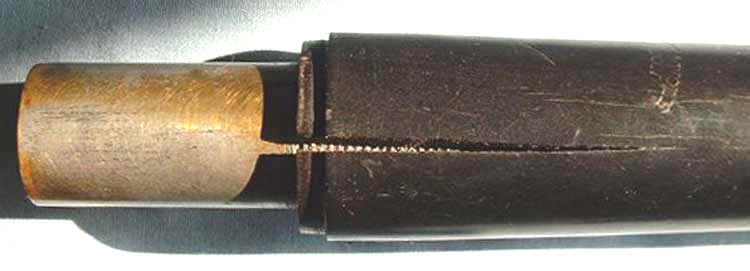
The moral is obvious - wood must not be lined
with metal or anything else that will resist the natural movement of
the wood during variations in humidity.
My policy
It has never seemed right to me as a maker to
perpetuate these
problems, and so I have always tried to steer buyers away from
traditional tuning slides. Cracking is the major issue,
especially given that there is no reason why a well made
instrument should not still be in use hundreds of years later.
Paradoxically
most 19th century flutes in museums are cracked in both head and
barrel.
Most 18th century flutes (before the tuning slide was invented)
aren't. Who wants to make (or buy?) an instrument which may
render itself
unplayable in one to ten years? I want to make instruments
that will be handed down and played for centuries!
It won't happen to me!
How do you know if this is likely to affect
you? Your
climate is the guide. Will your instrument experience very
dry weather for more than a week at any time in the year?
Answer yes if you live in a very dry place. Answer yes also
if it gets very cold in winter and particularly if it snows or if
you have central heating. Answer yes if you have air
conditioning in summer. In fact, answer yes unless you live
in a climate that is medium to moist all year round!
Ummm, how moist?
The Royal College of Furniture, London,
recommends that timber for musical instrument purposes should be
seasoned to an Equilibrium Moisture Content (EMC) of 12%. (These
are figures from the 1980's - the RCM's successor is likely to
recommend drier figures these days, consistent with the increasing use
of central heating and air conditioning. The 1980's figures will
be closer to the 1850's reality.)
This moisture content equilibrates to a relative
humidity in the air of about 65%. Compare these other recommendations
to see where you might fit in:
- 16% UK outside furniture [80%]
- 12-14% Occasionally heated rooms (UK) [70%]
- 11-13% Normally heated rooms (UK) [65%]
- 9-11% Continuously centrally heated rooms (UK) [55%]
- 9-11% General level for southern and coastal regions of USA
[55%]
- 8% Most northern and central regions of USA [40%]
- 6-8% Radiator shelves and arid south west of USA. [35%]
(the leading figures are EMC, the figures in []
are the equivalent %RH in the air.
From this we can see that 19th century
instruments, probably made in occasionally heated or normally heated
rooms in the UK should be kept humidified to 65%RH or more. And
if you live in the US, you can see from the lower part of the table how
much drier your climate is. Modern instruments made in the UK or
Eire can be expected to have similar requirements for care.
A Way Forward
But does it have to be like this? Can't we
have the
benefits of the tuning slide without its attendant problems? At
last, yes! But expect a few iterations along the way...
The New Improved Tuning Slide Mark I
This was a complete rethink of the tuning slide
issue and, I
believe, a new development, perhaps the first real development in
the eight key flute since the days of the old London makers. With
the Mark I slide, no part of the slide is encased in wood, so
cracking through shrinkage is entirely eliminated.
The slide goes nowhere near the embouchure hole;
consequently,
I cannot detect anything of the metallic edge to the sound I hear
from lined heads. It's hard to be sure, but I believe the sound is
indistinguishable from my unlined heads.
 |
Silver Mark I slide on a blackwood
flute |
The slide is made from hard drawn sterling silver
and is thus
sturdy and smooth in operation.
The slide also brings other benefits. Because the
usual wooden
barrel socket is replaced by a metal socket, the joint comes
together and apart very smoothly. This socket is much stronger
and thinner. This means that the upper tenon on the middle joint
can be thicker - this tenon is weak in the old flute. Further,
the thickness of the upper part of the midjoint can be reduced,
making the flute more comfortable to hold in the left hand.
So the Mark I slide is more than just a slide, it
brings a new
look and new functionality to the eight key flute.
The New Improved Tuning Slide Mark II
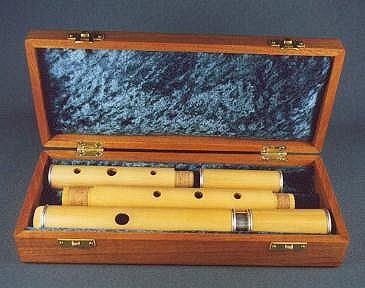
For those wishing to retain the old flute look, I
developed the New Improved Tuning Slide Mark II. It looks
identical to the traditional tuning slide. Whereas the
traditional slide completely lined the head and barrel, the Mark
II only enters 20mm (3/4") into each. This in itself is not
enough
to prevent cracking - plenty of old and new flutes have partial
slides and have cracked at these points.
|
Instead of being held fast by the wood, the
new slides are lapped in tenon cork, and in fact can be removed if they
need attention. The resilient layer of cork permits the wood to
move with the seasons without creating the kind of stresses needed to
crack it.
The tubes of the Mark II slide are made by
the traditional seamed method, hammered round on mandrels; the inner
tube being then turned and polished to fit the outer.
|
|
The New Improved Tuning Slide Mark III
This is a variation on the Mark II slide and
retains its
strategies to beat cracking. Instead of the outer slide being a
solid tube of sterling silver, it is now a brass tube with a
solid sterling silver cover in the part visible in the gap
between head and barrel. This offers several advantages over a
solid tube of silver:
-
a slide made of dissimilar metals runs very
smoothly
-
brass can be hand-reamed for the finest fit
-
I can use specially hard-drawn seamless
tubing for all parts
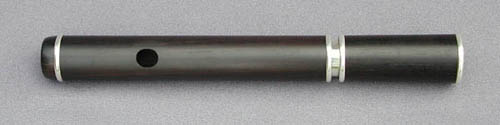
The Mark III slide looks identical to the Mk II
and to the 19th
century slides, except that the inner tube is silver, whereas the
19th century flutes used nickel plated brass.
And now ... the New Improved Tuning Slide Mk IV
This is essentially identical with the previous
Mk II slide,
apart from its mode of construction. It takes the ultimately
simple form
of two hard-drawn silver tubes. A new process, termed "fluid
force", forms the tubes from sterling silver slugs. Benefits are:
-
elegant simplicity - only two parts
-
both tubes are seamless
-
all sterling silver to minimise corrosion
-
extremely hard-drawn to minimise wear and
damage
-
uniformity of size permits interchange of
heads
The appearance of the finished instrument is the
same as in the image above. The internal structure is shown in
the sketch below.
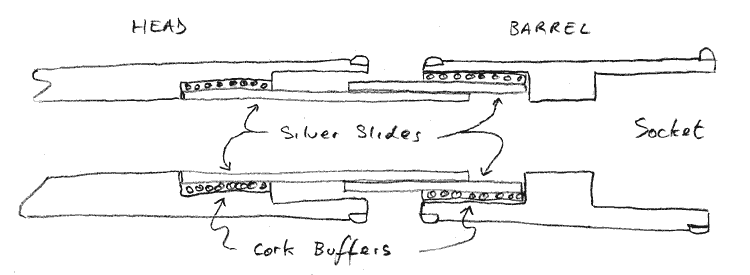
It can be seen that the two silver slides only
partially line the head and barrel, and are buffered from the wood by a
layer of tenon-cork. This is the important part, permitting the
wood to swell and contract
with changes in humidity.
Retrofitting
Players with my (or indeed any maker's)
previously unlined
heads can opt to have the new slide "retro-fitted". As
this will make use of the original head, there will be no
breaking-in period involved.
Maintaining the New Improved Tuning Slide
Should the slide become tightened through damage
or loose
through wear, it can be adjusted by any woodwind repairer using
the standard Boehm flute head swedging and expanding tools. Like
any
slide, it's important to clean off any breath condensate from time to
time, and
to lubricate the metal with a little cork grease or similar substance.
Because the embouchure area of the headjoint
remains unlined,
players will still have to mop out their headjoints after playing
(which you should do anyway even with a lined joint to prevent
corrosion forming and bacteria growing!). The wooden section will
also require oiling periodically. This is the same as for an
unlined head and for the rest of the instrument of either type.
Other Makers:
I do not claim these to be the only or best
solutions to the
tuning slide question - but they are perfectly satisfactory ones.
I do
assert that continuing to use the old style tuning slide will, sooner
or later,
mean that your work will suffer cracks which are hard to repair
elegantly and
which, it can now be seen, are preventable.
I am quite happy for other makers to adopt my
designs for
their own instruments asking only that they acknowledge them as
'Terry McGee's "new improved tuning slide"' or
something similar. In the same way, I'm keen to hear of and
acknowledge any developments to the eight key flute that you might
make. This way, the eight key flute will cease to be seen
as just the primitive predecessor to the Boehm flute and will be
seen for what it is - a different and equally valid instrument
following its own developmental path.
Use your browser back button to return to how
you got here, or
Back to
McGee Flutes home page...
Created: 11 June 2001
|