|
The
emphasis in the current revival of interest in 19th century wooden flutes
has been on London-made instruments, particularly on the instruments of
Rudall & Rose, and later Pratten. But flute-making had become
big business in the US too, particularly around New York. We'll look
at a flute by famous American maker, William "General" Hall.
Company
History
The
New Langwill Index tells us that Hall was born in Sparta in 1796 and was
apprenticed to a musical instrument maker in Albany (possibly Meacham)
until 1812, when he joined the militia. After the war, he moved to
New York, working for Edward Riley, whose daughter he married. In
1820, he set up independently, a year later joining with John Firth (who
had also worked for Riley and married one of his daughters) as Firth &
Hall. In 1831, they were joined by Sylvanius Pond (Firth, Hall and
Pond). He left that company in 1847 to set up with his son James as
William Hall & Son. They seemed to have moved into piano
manufacture by 1850, ceased exhibiting flutes by 1869; James left the
company in the following year and it was bought up by Ditson in 1875.
The
flute we will look bears the mark:
WILLIAM
HALL & SON
239 BROADWAY
N.YORK
The
company seemed to retain that address between 1848 and 1858.
Nicholsonian
Leanings
Charles
Nicholson published his "A School for the Flute" in London in
1836. The two volumes were reproduced for sale in the US by William
Hall & Son. They add the comment at the bottom of page 6:
"NB.
The publishers of this work would beg to say they are extensively engaged in
manufacturing flutes after Nicholson's patteren (sic) and would recommend
purchacers (sic) to call an examine them.
Unfortunately,
the reproduction is undated, but carries the address 239 Broadway,
suggesting a date after 1848. That seems a late date for such a
publication however.
Nonetheless,
it gives us reason to expect a English style of flute from the General,
rather than the German-inspired flutes of some of the other US makers.
Indeed, it leads us to expect a Nicholsonian flute of some degree - that is
to say a flute of larger proportion than the Astor flute that Nicholson's
father
modified. A flute like that would have holes around 6.5mm maximum.
The
Flute
And
here it is, long, thin and elegant:

Hard
to be sure about the wood - it could be a particularly red piece of cocus,
or perhaps rosewood. As you can see, the head and barrel are a little
redder than the rest, though this might be because of refinishing.
|
Unusual
features
There
are quite a few features that set it apart from London-made flutes of
the time.
|
The angled G#
English flutes normally have a G# that runs parallel to the
body. German flutes use an angled G# but implement it in post
mounting. Occasionally, you see blockmounted angled G# keys, but
these are hard work and therefore rare. Note how the block is orthogonal, but the slot and pin
are set at the angles needed. |
 |
 |
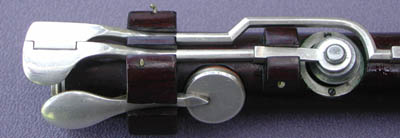
Low Profile Short F
The Short F key touch is made circular, set low and given a hole
underneath it to descend into. Like some English flutes, it's also
twisted slightly to facilitate moving the R3 finger to it more easily. |
Foot key touches
The overlap between the touches for low C and C# is handled very
neatly. |
 |
|
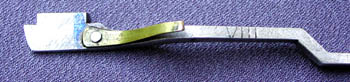
Key Marking
The mark (VIII) shown to the left appears under each of the
keys.
I have a feeling I've seen it somewhere before ... |
Countersunk key seats
As we'll see later, the key holes are not large. This brings
the risk of attendant noise. Hall has employed a trick used by
oboe-makers - the hole is countersunk to improve the aerodynamics. |
 |
Vital Statistics
|
| Sounding
Length, minimum |
581.7 |
|
|
| Sounding
Length, at A=440 Hz |
604.7 |
|
|
| Cylindrical
Length, minimum |
127.7 |
|
|
| Cylindrical
Length, at A=440Hz |
150.7 |
|
|
| Conical
Length |
454 |
|
|
| E to End
Length |
159.5 |
|
|
| Head bore |
18.9 |
|
|
| Top of Cone
bore |
18.2 |
|
|
| Minimum Bore
(from top of cone) |
10.35 |
@ |
437 |
| End of cone
bore |
10.6 |
|
|
| Cone average
slope (to minimum) |
-55.7 |
|
|
| Cone average
slope (after minimum) |
68.0 |
|
|
| Proportional
reduction at top of cone |
96% |
|
|
| Proportional
reduction at minimum |
55% |
|
|
| Proportional
reduction at end |
56% |
|
|
| Embouchure
hole Length |
12.85 |
|
|
| Embouchure
hole Across |
11 |
|
|
| Size of B
hole |
8.9 |
|
|
| Size of F#
hole |
9.3 |
|
|
| Outside
Diameter at Embouchure |
28.8 |
|
|
| Outside
Diameter at Hole 1 |
26 |
|
|
| Outside
Diameter at end of RH section |
23.6 |
|
|
| Spacing LH1
- LH2 |
36 |
|
|
| Spacing LH2
- LH3 |
37 |
|
|
| Spacing RH1
- RH2 |
32 |
|
|
| Spacing RH2
- RH3 |
37.5 |
|
|
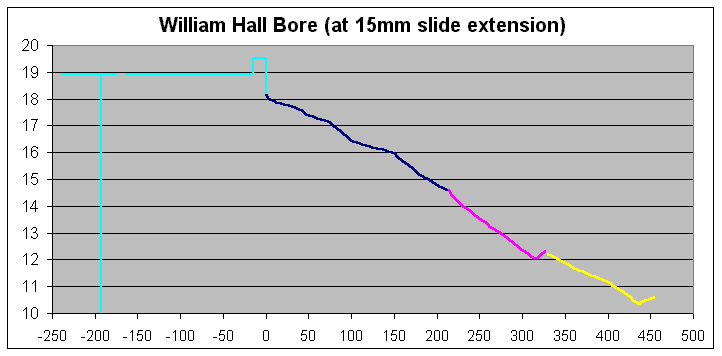
A typical bore
The chart
below illustrates the bore of the flute in rather exaggerated terms,
without which we would have no way of appreciating fine
detail.
In aqua, we
have the head and barrel bore. The vertical line represents the face
of the stopper, the effective top of the flute. The gap in the
horizontal trace is the embouchure. I've chosen to illustrate the
head bore with the slide partially extended, to show the relatively large
perturbation (compared to the vagaries of the conical section of the bore)
that this represents.
In dark
blue, we have the left hand section. Note immediately that it starts
at a diameter considerably smaller than the head bore.
Following
on, in pink, we have the right hand section. Note the interesting
kink towards the lower end. This might be just bore compression due
to an overtight winding of the lapping, or might be there
intentionally. Rudall & Rose flute exhibit this peculiarity, but
it would be seen on the lower end of the left hand section as well.
Finally, in
yellow, the foot. As is commonplace, it reaches a minimum a little
before the end of the bore, expanding slightly for the remaining section.
Flute
Performance
Just
like the London-made flutes of the first half of the 19th century,
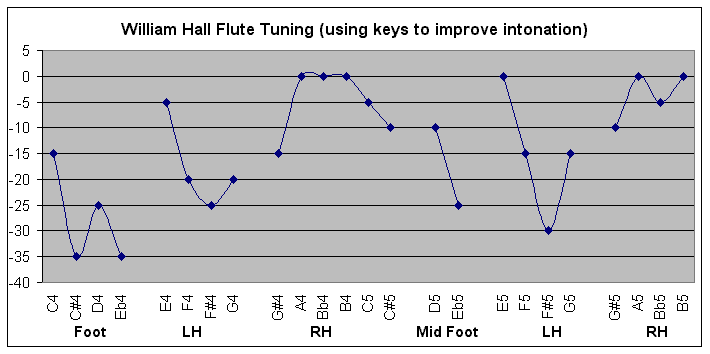
intonation isn't all we would prefer. Indeed, the same general pattern
of tuning issues manifests itself:
-
the
foot notes (C, C#, D and Eb in the first octave and D and Eb in the
second) are particularly flat
-
of
these, C# and Eb are flatter than D which is flatter than C
-
F#
is also quite flat
-
Some
of the keyed notes are flat (F and G# in particular)
-
G
is flat.
This
tuning chart tells the story:
Looking
for reasons, the Venting Chart is helpful:
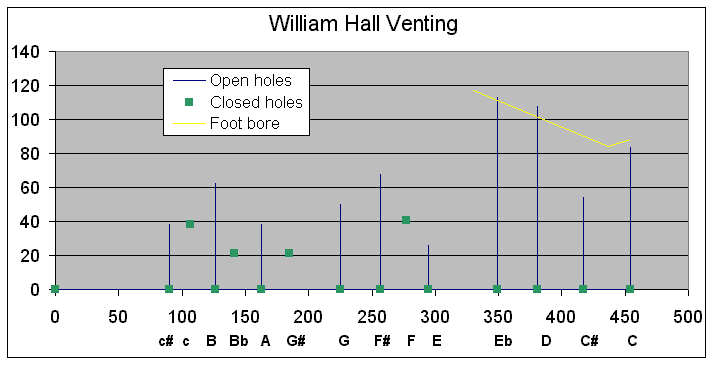
We see:
-
a general
similarity between this flute and R&R 742,
in terms of overall lengths,
-
hole sizes
are more similar to medium-sized English 2nd Generation flutes
-
a long gap
between G# and the G hole. The tiny size of the G# hole and the
long way to the next vent hole explain the flatness of this note,
-
the long gap
between the left hand cluster and the right hand cluster explains the
relative flatness of the right hand notes (in both octaves),
-
the further
big gap between the right hand cluster and the foot notes ensures that
the foot notes are even flatter,
-
F# gets no
useful venting support and simply isn't big enough to get that note up
to pitch
-
Because F#
is flat, G suffers for want of venting and is also flat,
-
F is too
small and too low (compare the G# to G semitone with the F# to F
semitone)
-
Low C# is
well spaced between D and C but very much smaller, so it ends up particularly
flat
-
Eb is bigger
but needs to move up a bit
Conclusions
Summarising
all the above, we can see the definite influence of English flutes on the
work of Hall in New York. This flute best resembles the medium-holed
flutes made by English makers such as Rudall & Rose. As such it
brings the same kinds of challenges, particularly in terms of flat foot
and the other classic intonation issues.
Acknowledgements
Thank you to
Canberra Flute Player, Michael Stone, for the opportunity and permission
to bring this story to you.
More to come
The ACT
Government, through its Cultural Council, has enabled a further study of
flutes by William Hall, by funding a collaboration with American player
Grey Larsen to be in Australia this Easter. We'll be bringing you
the outcome of that study on these pages.
Back to McGee Flutes
Contents Page
Created: 13 Jan 2003 |
|